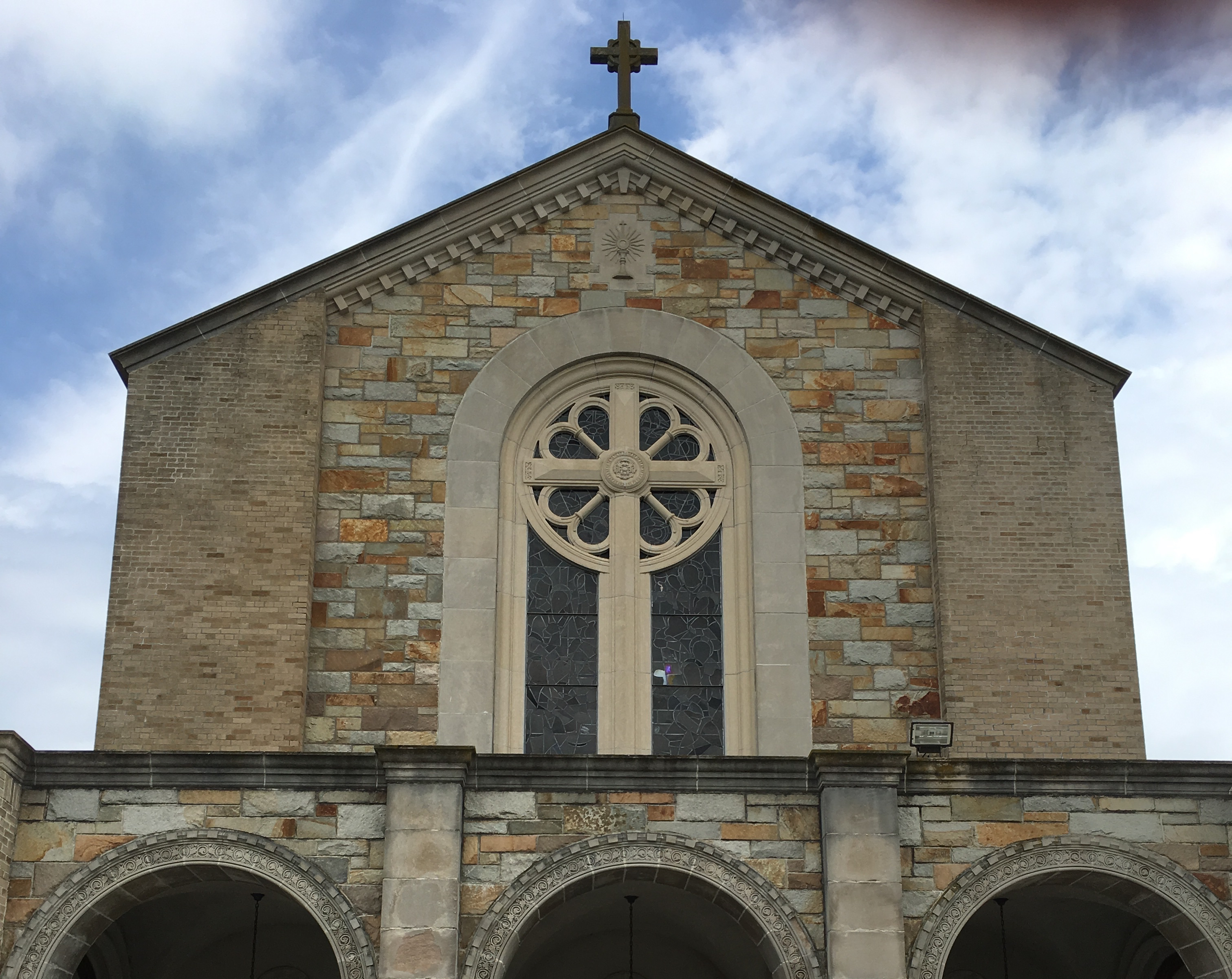
Temple of the Holy Spirit

“Do you not know that your bodies are temples of the Holy Spirit, who is in you, whom you have received from God?  You are not your own; you were bought at a price.  Therefore honor God with your bodies.”  (1 Corinthians 6:19-20)

Have you ever heard a sermon about caring for your body?  I have not.  And this strikes me as odd, given that Paul tells us that our body is the temple of the Holy Spirit and that we are to honor God with our body.  Indeed, it is through the body that all aspects of our spiritual life are mediated.  We think, we feel, and we act, for better or worse, through our body.  There is no physical or spiritual action that we undertake that does not involve the body.  Moreover, our physical condition can materially affect our pursuit of Kingdom virtues.  For example, consider how difficult it is to show kindness and compassion to others when we are tired.  Jesus described this when three of his closest disciples could not stay awake with him as he walked in garden of Gethsemane the night before he was crucified.  His plaintive yet insightful words, “the spirit is willing, but the flesh is weak.” (Matthew 26:41)  Our willpower is at a low point when we are weary, which makes us more vulnerable to temptation and sin.  Or consider how our stamina declines when we are overweight or out of shape.  Jesus’ command is, If anyone forces you to go one mile, go with them two miles.”  (Matthew 5:41)  This is assumed by the modern reader to be a metaphor.  But Jesus’ reference was from real life at the time, because a Roman soldier could force a citizen to carry his load for up to one mile.  How many Christians could even walk a single mile today, let alone two while carrying a heavy load?  The point being that our ability to serve is directly impacted by our physical condition.

Others have noted that our body is made by God, and that we are to use it to glorify him.  According to Rick Warren, “Your body is holy because God made it, and everything God makes has a purpose.  We are to bring glory to God with our bodies, so we can’t compartmentalize our lives and think that we can divorce our bodies and live as if only our spirit matters.  God owns your body!”  And yet most of our Christian leaders seem reluctant to teach a theology of caring for our bodies.  The reasons are no doubt complicated.  I suppose that a principal one is that failure to care for our bodies is self-evident.  Given that roughly 2/3 of adults in our country are now considered medically obese, one does not have to look very far on a Sunday morning to identify the guilty.  This is not a trivial concern because shaming people is itself contrary to the love we are committed to show to others.  And yet it is this same love that compels us to kindly speak the truth to those who may be on a slippery path.  It is ironic that we Christians crusade for the sanctity of human life, from the preborn to the end of life, and often take a stand against selected substances we put into the body such as alcohol, tobacco, drugs, etc.  And yet, as soon as anyone suggests that caring for our body is a moral imperative, we quickly change the subject.

The practical reasons to care for the body are well known.  The medical justifications alone are overwhelming – everything from preventing heart disease and diabetes to averting many cancers.  Moreover, there are affirmative health benefits – from increased energy and stamina to quality and length of life.  It can also have a positive impact on our emotions.  When I started running regularly in 1979, I found that the mood swings I had experienced for many years disappeared overnight.

But is caring for our body a Christian virtue?  Or is it a purely private matter?  I think it is fair to say that many people in the church consider it to be the latter, with no more right or wrong to it than the color of socks they pull out of a drawer in the morning.  On the other hand, there are some who look at how we care for our body as a matter of honoring God – being more akin to other Christian virtues that are commanded in God’s word.  Consider the three most critical areas of proper body care: rest; exercise; and diet.

Rest
Rest is so important in the Bible, that there is an entire Commandment directed to it.  “Remember the Sabbath day to keep it holy.” (Exodus 20:8)  This command emerges directly from the nature of God, who after six days of creative action, rested on the seventh day.  The most well-known comfort psalm starts, The Lord is my shepherd, I shall not want.  He makes me lie down in green pastures, he leads me beside quiet waters, he restores my soul.” (Psalm 23:1-3a)  Notice that the Lord makes me lie down.  He doesn’t suggest that I lie down, just as he doesn’t suggest that I rest on the Sabbath, he commands it.  Not to put too fine a point on this, but I believe God understands the tendency of many of us to shortchange our time of rest.  We are either too busy, or too distracted, or too preoccupied with other things and our rest is sacrificed.

Proper rest is essential for spiritual growth.  According to Christian author Jim Smith, “The number one enemy of Christian spiritual formation today is exhaustion… The human person is not merely a soul housed in a body.  Our bodies and souls are unified.  If our bodies suffer, so do our souls.  We cannot neglect the body in pursuit of spiritual growth.  In fact, neglecting our bodies necessarily impedes our spiritual growth…  If our bodies are not sufficiently rested, our energies will be diminished and our ability to pray, read the Bible, enter solitude or memorize Scripture will be minimized.”  (The Good And Beautiful God)

Exercise
Physical exercise per se is not mentioned very much in Scripture.  No doubt this has a lot to do with the times in which the Bible was written.  For the most part, the common people were living a hardscrabble existence.  Whether making bricks for their Egyptian masters, wandering in the desert, or struggling under Roman rule, daily life inherently involved hard physical labor. The idea that one day large numbers of people would live sedentary lifestyles – from desk jobs to computer games – was incomprehensible to the ancients.  Of course, physical training for sporting events was understood in the Roman world, and while Paul knew it had value, he framed it within the broader issue of holiness.  “Physical training is of some value, but godliness has value for all things, holding promise for both the present life and the life to come.”  (1 Timothy 4:8)  Still, Paul believed that our bodies are to be offered as a sacrifice to God.  “Therefore, I urge you, brothers and sisters, in view of God’s mercy, to offer your bodies as a living sacrifice, holy and pleasing to God – this is your true and proper worship.”  (Romans 12:1)

Sloth, which is laziness and the avoidance of work, has long been viewed by the church as one of the seven deadly sins.  There are a number of teachings regarding sloth in the Bible.  For example, Through sloth, the rafters sag; because of idle hands, the house leaks.” (Ecclesiastes 10:18)  “The way of the sluggard is blocked with thorns, but the path of the upright is a highway” (Proverbs 15:9)  The virtue that stands in opposition to sloth, is diligence, which speaks to the ability to apply oneself to the task at hand.  Although not uniquely applied to physical exercise, sloth and diligence often form the battle lines in the fight for our body.

I believe physical exercise is a virtue because a well conditioned body best positions us to live out other Christian virtues.  There is a tendency I think for us to see physical exercise only from the perspective of our own health – to view it as a means to feeling better in and of ourselves.  While this is a benefit, a properly functioning body enables us to serve others.  It can determine whether we have the strength to walk with a friend, help a neighbor, play with a child, travel on a mission trip, or serve in a food pantry.

Diet
What we eat and drink are of concern to God. He gave the Israelites very precise guidelines on what they were to eat and how to prepare it.  And also what they were to avoid.  The story of Daniel proposing and following a diet that avoided certain foods is a classic example of the importance of what we eat and drink in our spiritual journeys.  Indeed, many of our Christian brothers and sisters who fast, do so as a so-called “Daniel Fast” (vegetables in lieu of meat, wine, and other rich foods).  Gluttony, which is over-eating, has classically been viewed by the church as one of the seven deadly sins.  This is supported by various references in Scripture.  For example, Do not join those who drink too much wine or gorge themselves on meat, for drunkards and gluttons become poor, and drowsiness clothes them in rags.” (Proverbs 23:20-21)  Abstinence is one of the seven contrary virtues that has historically been recognized in opposition to gluttony.  These days, abstinence has taken on a decidedly sexual connotation, which all but hides its broader meaning to control those desires that would tempt us to overindulge in any area of our life.

Self-control, which is mentioned by Paul as a fruit of the Spirit, is one of the key virtues involved in regulating our eating habits (and for that matter, rest and exercise as well).  I particularly like this description of self-control:  Self Control is dominance over all desires.  It is one of the most important spiritual virtues that are essential for growth in the knowledge of God, pursuit of the Truth, and attaining of our future destiny.”  (Anonymous)  The Biblical image is powerful, Like a city whose walls are broken through is a person who lacks self-control.”  (Proverbs 25:28)  Although self-control has a more expansive meaning for Christians, it nonetheless is a gateway virtue for the care of our body.  If we lack self-control in what we eat and drink, it seems probable that we will lack self-control in other areas of our physical and spiritual lives as well.

Caveats
For those who agree that caring for one’s body is important for spiritual health, there are several caveats that must be mentioned.

First, we must be ever vigilant that in caring for our body we don’t drift into sin.  Too much rest can become laziness and sloth.  Too much focus on what we eat can become an eating disorder.  And too much exercise can lead to idolatry of our body.  We live in a culture that worships the perfect human body and those fortunate enough to have the time and underlying physical abilities can easily turn any of these virtues into a vice.  And, of course, overhanging all of these sins is the greater sin of pride, which is the complete anti-God state of mind.

Second, many of us also have significant limitations related to our health and/or aging.  For us, our temple of the Holy Spirit has sprung some leaks and is slowly perishing.  Indeed, we can never escape the fact that the body that is sown is perishable.” (1 Corinthians 15:42)  It is also certain that at one time or another each of us will enter a season of life where obligations and duties leave little time for exercise.  At such times, we need not add any measure of guilt to already stressed out lives.  Rather, our goal should be to provide whatever care we can give with the time we have.

Finally, we must not elevate the care for our body above other Christian virtues.  Who among us would not rather live with a spouse who is out of shape but kind hearted, rather than perfectly fit and mean spirited?  The adage that beauty is only skin deep is a good reminder.  Not dissimilar from the words of God to Samuel when he was looking for a replacement king for Saul, The Lord does not look at the things people look at.  People look at the outward appearance, but the Lord looks at the heart.”  (1 Samuel 16:7)

Final Thoughts
I am convinced that care for our body is a Biblical imperative.  God provides simply too much direction for its care for us to ignore.  As in all areas of our spiritual lives, we must be on guard against compartmentalization.  Everything must be consecrated to God, to his will and his glory alone.  William Law, 18th Century Anglican author of the classic Christian devotional A Serious Call to a Devout and Holy Life,” wrote the following:  “The devout are people who … consider God in everything, serve God in everything, and make every aspect of their lives holy by doing everything in the name of God and in a way that conforms to God’s glory.”

Whether our focus is on caring for our body or any other Christian virtue, what matters is whether our actions are pleasing in the sight of God.  Our touchstone must forever be found in the words of Paul, “Whether you eat or drink, or whatever you do, do it all for the glory of God.” (1 Corinthians 10:31)

S

Night Sky

The heavens declare the glory of God; the skies proclaim the work of his hands.  (Psalm 19:1)

The first time I remember seeing the Milky Way was the summer of 1974.  In May I moved from my parents’ house in suburban Maryland to fifty acres of abandoned farmland in rural Maine. There were no structures on the land save a dilapidated chicken coop, which I briefly contemplated occupying on a temporary basis.  But rotten floorboards, low ceiling, and general lack of hygiene from the previous tenants soon convinced me to abandon the idea.  And so, I opted to sleep in a tent for the summer months while building a cabin for the coming winter.  It was a time of living close to the land and the elements – other than sleeping and an occasional drive into town I was out-of-doors all of the time.

Occasionally I would head out of an evening and walk a little more than a mile down two dirt roads to the home of a retired seaman, known simply by his naval title, Chief.  Chief was of Scandinavian descent, and true to his heritage had built a free-standing, wood-fired sauna just off to one side of the old farmhouse where he lived.  On Wednesday and Saturday afternoons Chief would build a fire inside the sauna to superheat a cache of river stones.  Later on, some of the locals would gather and swap tales underneath a large maple tree in the front yard while waiting a turn in the sauna.  When one group emerged others of us would enter and perch on cedar benches from where an occasional cupful of water would be tossed on the stones to generate a plume of steam to intensify the heat.  After sweating out what seemed to be a week’s worth of dirt and rinsing with cold water from a nearby stream, the body felt clean like never before.  It was almost like the skin itself was breathing – a tingling sort of respiration that somehow made the walk back home all the more wonderfully sensuous.

It was on one of these nights, when the moon was dark and the air refreshingly cool and clear as it often is in Maine on summer nights, that the stars shown more brightly than I ever remembered.  Looking up, I saw what appeared to be a silky veil stretched across the heavens from horizon to horizon.  I presumed this to be a thin cloud floating overhead.  But this was no cloud, as I would later discover.  Rather, it is the galaxy of stars known as the Milky Way – billions upon billions of stars shining in the night sky.  Just so many faint points of stellar radiance merging on a clear night into a delicate curtain of starlight.  Those fortunate enough to view it receive a glimpse into the universe like no other.

It’s strange to think I lived nearly a quarter of a century without seeing the Milky Way.  In part, this was due to my general disinterest of celestial matters – not really caring much about the heavens.  But significantly, it was also due to so-called “light pollution” – a phenomena caused by outdoor lights, particularly near cities.  The light from these outdoor sources shines upwards in the night and is partially reflected back to the earth by our atmosphere.  The reflected light is just bright enough to obscure fainter objects in the night sky such as the Milky Way.  Having lived most of my life near Baltimore, Philadelphia and Washington D.C, I had been surrounded by lighted nights.  But this was not the case in the remote hill country in the central part of Maine where I had moved, which was one of the last areas east of the Mississippi not affected by light pollution.

But even as my physical eyes were slowly being opened to the created universe, my spiritual eyes were still in the dark.  In part, this was due to my general indifference to religion and the supernatural.  But equally, I was living in the midst of a sort of spiritual light pollution.  This took the form of much of what I had been taught in school from naturalism in biology, to relativity in physics, to “all religions are the same” in philosophy.  There was also much in the culture that reflected a secular rather than religious worldview.  I don’t recall a lot of overt teaching against the existence of God, but among many people I knew there was a general disinterest if not disdain regarding matters of faith.  It was all just enough to make me feel comfortable in a life centered around me – a life that did not have to question where I was going or who I was becoming.

Unlike the failure of my physical eyes to see the Milky Way, the blindness of my spiritual eyes had real life consequences.  For during my years homesteading in Maine, the self-centeredness that is a natural outflow of the secularism I followed resulted in my estrangement from three good friends and damaged relationships with several others.  It was all too easy to dismiss a Creator God and his law as a guide for my life, but it remained to be seen how I could ever live a basically good and decent human existence otherwise.  The life I was living – with me at the center – treated people as objects to achieving my goals, controlled others through anger, and was generally unforgiving and unloving.  No amount of time in a sauna could ever clean up the mess in my innermost being.

But as I stared at the night sky that summer, God was at work on my soul. For thoughts about creation and whether there was a Creator began to stir.  When I looked to the heavens I began to wonder about how they were created, and even deeper, “Why should anything exist at all?  “Why isn’t there nothing?”  Unanswerable I thought, yet these questions were the birthing sounds of a spiritual journey.  Others I am sure have had similar encounters with the night sky.  For those with “eyes to see,” it is a glimpse of eternity and a signpost to a Power beyond the natural world in which we live.  But more than just a signpost, Paul taught that the created universe is clear evidence of God, “For since the creation of the world God’s invisible qualities – his eternal power and divine nature – have been clearly seen, being understood from what has been made, so that people are without excuse.” (Romans 1:20)  For me, it would be many years before I connected the beauty of the created order with a personal God, and much longer before I understood that this personal God has an equally beautiful design for the human experience – a design that is embodied in his revealed law.  That night was the first small step in a spiritual journey.

Years later when I eventually came to know Jesus as Savior, I found that he correctly diagnosed my condition,For the mouth speaks what the heart is full of.  A good man brings good things out of the good stored up in him, and an evil man brings evil things out of the evil stored up in him.” (Matthew 12:34-35)  The reason my relationships were a mess was because of the mess inside of me.  As long as my primary focus was on me, conflict was sure to follow.  Jesus also had the solution to my condition, “If you hold to my teaching, you are really my disciples. Then you will know the truth, and the truth will set you free.” (John 8:31-32)  In other words, the solution to my spiritual problem was to hold to Jesus’ teaching, which is the will of the Father – the law of God.

Unbeknownst to me, even as God opened my physical eyes in 1974 to the beauty of the night sky, one day he would also open my spiritual eyes to behold the beauty of his Kingdom.   Somewhat surprisingly, this did not occur when I placed my faith in Jesus in 2000.  Instead, it would be another decade before I began to understand that faith in Jesus means to hear his word and obey.  In other words, to “seek first the kingdom [of God], and his righteousness” (Matthew 6:33).  Jesus makes it clear that obedience to the law of God, which he fleshed out in much of his teaching, is the only way into the kingdom of heaven.  (Matthew 7:21)

I have known life without God and it came at a very dear price indeed. Jesus tells us that anyone we follow, other than him, is a thief and that, “The thief comes only to steal, kill, and destroy” (John 10:10a)  The life I was living in 1974, centered around me, killed and destroyed many relationships, and stole my joy.  In contrast, Jesus says, “I have come that they may have life, and have it to the full.”  (John 10:10b)  This is a life centered around God – life in his kingdom, which is a matter of “righteousness, peace, and joy in the Holy Spirit.” (Romans 14:17)  I have found that kingdom life has a beauty that surpasses even that of the night sky.  Paul speaks about the fruit of the Spirit, “love, joy, peace, patience, kindness, goodness, faithfulness, gentleness, and self-control.”  (Galatians 5:22-23)  These are not abstract concepts but real life qualities that seem to increase as I pursue the virtuous life commanded by God.

Psalm 19, which CS Lewis called “the greatest poem in the Psalter,” praises with equal voice the beauty of the heavens and the beauty of God’s law. The beauty of the heavens reflected in a clear night sky and the beauty of God’s law reflected in a life of virtue.

The beauty of the heavens:
“The heavens declare the glory of God; the skies proclaim the work of his hands.  Day after day they pour forth speech; night after night they display knowledge.  There is no speech or language where their voice is not heard.  Their voice goes out into all the earth, their words to the ends of the world.  In the heavens he has pitched a tent for the sun, which is like a bridegroom coming forth from his pavilion, like a champion rejoicing to run his course.  It rises at one end of the heavens and makes its circuit to the other; nothing is hidden from its heat.”  (Psalm 19:1-6)

The beauty of God’s law:
“The law of the Lord is perfect, reviving the soul.  The statutes of the Lord are trustworthy, making wise the simple.  The precepts of the Lord are right, giving joy to the heart.  The commands of the Lord are radiant, giving light to the eyes.  The fear of the Lord is pure, enduring forever.  The ordinances of the Lord are sure and altogether righteous.  They are more precious than gold, than much pure gold; they are sweeter than honey, than honey from the comb.  By them is your servant warned; in keeping them there is great reward.  Who can discern his errors?  Forgive my hidden faults.  Keep your servant also from willful sins; may they not rule over me. Then will I be blameless, innocent of great transgression.  May the words of my mouth and the meditation of my heart be pleasing in your sight, O Lord, my Rock and my Redeemer.”  (Psalm 19:7-14)

When I viewed the Milky Way in 1974, I was seeing starlight that had been emitted over 20,000 years earlier.  When I read God’s word, I was hearing his law that had been spoken over 2,000 years earlier.  Ancient sights and ancient words – the beauty of a night sky and the beauty of God’s law – beacons of light to a dark soul.

S


No Man Is An Island

“No man is an island entire of itself; every man is a piece of the continent, a part of the main; if a clod be washed away by the sea, Europe is the less, as well as if a promontory were, as well as any manner of thy friends or of thine own were; any man’s death diminishes me, because I am involved in mankind.  And therefore never send to know for whom the bell tolls; it tolls for thee.”  (John Donne)

Is there anything more romantic than an island?  Pat and I spent our honeymoon on Monhegan Island, a small rocky oasis some twelve miles off the coast of Maine.  It was the perfect island retreat for a young couple in love.  Completely cut off from the mainland save for one undersea cable, and before the days of satellite Internet coverage, there was nothing from the outside world to distract us.  Of course, we were not self-sufficiently alone.  We stayed at the Island Inn, an old-fashioned hotel perched high above the tiny harbor where, weather permitting, visitors and supplies disembarked.  Over the years we have visited other islands, and always the romance of that first island stay is rekindled.  Even now, landlocked on a great continent, I sometimes hear the call of an island – a far land where I retreat whenever the stress of living threatens to overwhelm my soul.  It is an imaginary place to escape the reality of life when I am feeling overwhelmed by people and events.

To a large degree the American experience is that of self-sufficiency.  From the earliest days, we were a land of immigrants who were willing to forsake friends and family to sail to the new world.  We eventually fought a war for independence, which we proudly proclaimed in a great Declaration to that effect.  Later on, we were pioneers who pushed steadily westward, and then homesteaders who built our lives on vast, lonely plains.  At the start of the Great Depression, President Herbert Hoover (a self-made millionaire) coined the phrase “rugged individualism” to describe a belief that people can make it on their own and government help should be minimal.  And today, those of us fortunate enough to live in great communities amid unbelievable affluence often as not pull into a garage, closing the overhead door behind us before exiting the car – alone again in our little island of a home. Although it is a fiction that we can make it on our own, we have elevated independence and self-sufficiency to national virtues.

But while these may be cultural virtues, nothing could be further from our calling as Christians.  For we know that we are not islands unconnected to others, but we are created and called to be inextricably tied one to the other.  The Apostle Paul used the human body as a metaphor to show our interconnectedness. “God has put the body together, giving greater honor to the parts that lacked it, so that there should be no division in the body, but that its parts should have equal concern for each other.  If one part suffers, every part suffers with it; if one part is honored, every part rejoices with it.  Now you are the body of Christ, and each one of you is a part of it.”  (1 Corinthians 12:24-27)  Indeed, no Christian can dispute that the call to interdependence is an essential feature of our faith, as we are commanded repeatedly in Scripture to be in close relationship to one another. For example, “Love one another” (John 13:34); Serve one another in love” (Galatians 5:13); “Be kind and compassionate to one another…” (Ephesians 4:32); “Submit to one another out of reverence for Christ” (Ephesians 5:21); and “Forgive whatever grievances you may have against one another” (Colossians 3:13).

In his poem, No Man Is An Island, priest and poet John Donne affirms this Biblical truth by rejecting the idea that we are islands, isolated from others; rather, there is a certain inescapable interdependence that we all have with one another.  And yet, there seems to be no lack of lonely people around us, living in tiny self-created worlds with few or no friends.  I see it at a local rehabilitation center in the faces of certain people who have no one to visit them.  I sense it in our neighborhood where some people keep their window shades perpetually drawn and they themselves seldom emerge.  And I sometimes feel it in my soul when wanting to avoid others and draw into myself.

The antidote for isolation and loneliness is a community of friends – those who mutually share the fears, challenges, and joys of their lives, who listen without judgment, who occasionally challenge with truth spoken in love, and who always encourage one another.  There are many types of relationships, even friendships we can have with others.  But a real and true friend is someone who really knows me and is known by me.

For years I had no friends outside my immediate family.  It wasn’t until I was almost fifty, when one Sunday morning a pastor pointed out that there were many men who had no friends.  His words struck home, and I trace my own pursuit of friends from that day – a pursuit that at times has been a stumbling, bumbling, and often faltering affair.  It has taken me time, a lot of time.  Most of what I have learned has been by trial and error.  Ironically, it has been more of an inner journey than an outer one – more of learning about myself than learning about others.  Over time, I have developed a circle of friends with whom I associate regularly.  Reflecting on my journey, I have several observations about the development of friends. These are neither prescriptive nor exhaustive, but are offered simply as a personal reflection.

A first observation is that relationships at work are not a substitute for having friends.  For many years I believed that workplace relationships were the only personal contacts I needed outside of my family.  I interacted with many people at work on a daily basis, even occasionally socialized with them.  But while workplace relationships can occasionally develop into real friendships, I believe that the things that mostly bind people together at work – forced interactions and a common employer do not in the long run support intimate friendships.  This fact was revealed when I retired and all contacts with people at work were instantly severed.  I know other men who have suffered after retiring because they never developed friends beyond work.

A second observation is that being an introvert does not excuse one from having friends.  As an introvert, I really enjoy times when I am alone to read, write, and listen to music.  These are all good things, but just because they are good and that I like doing them does not excuse me from developing friendships.  It may be that psychologists are correct when they claim that introversion is invariant.  But it seems to me that this can be used as an excuse for not engaging with others, in the same way that virtually any vice can be excused by thinking “that’s just the way I’m wired.”  We introverts don’t have to abandon our times of solitude, but we also should not allow it to dominate our lives.  In this regard it is worth contemplating a scene from The Great Divorce, in which C.S. Lewis envisions the essence of hell as increasing separation from one another. The illustration he uses is a person setting up home on a street (in hell), fighting with a neighbor, and moving farther and farther away. “As soon as anyone arrives he settles in some street.  Before he’s been there twenty-four hours he quarrels with his neighbor.  Before the week is over he’s quarreled so badly that he decides to move.  Very likely he finds the next street empty because all the people there have quarreled with their neighbors – and moved. So he settles in.  …  He’s sure to have another quarrel pretty soon and then he’ll move on again.  Finally … getting further apart. … Millions of miles from us and from one another.  Every now and then they move further still.”

A third observation is that hurts caused by other people can be an impediment to making friends.  I have found that when I am hurt by other people, I tend to pull away – not just from them but from everyone else as well. It is a defense mechanism I have used to avoid being hurt again.  Like many people, I have the scars of being deeply hurt by others over the years.  Many of these hurts go back to childhood when the soul was so very tender.  These hurts can set in motion defensive patterns of behavior that can be very hard to overcome, and I have no easy answers for doing so.  I know some people who have been helped by programs such as Celebrate Recovery.  I received direct healing from the Lord, as I prayed one day over a conflict I was having with an acquaintance.  The Lord showed me that I did not need to fear rejection by others.  Although I am still hurt from time to time, I am better able to forgive and avoid retreating.

A fourth observation is that my pride is the biggest impediment I have to developing friends.   I can’t even begin to explain how deep the roots of pride are in my life because honestly I don’t see all of them.  This is pretty much what C.S. Lewis writes when he refers to pride as “The Great Sin” in his book Mere Christianity.  “There is one vice of which no man in the world is free; which every one in the world loathes when he sees it in someone else; and of which hardly any people, except Christians, ever imagine that they are guilty themselves. … The vice I am talking about is Pride.”  I tend to pull away from others when my ego is not stroked enough or my ego is offended.  When I first joined a men’s small group, I measured the success of a meeting by how much I was affirmed by the others.  What a burden it became to always have to focus on myself – always thinking about what I would say and how I could be praised.  There is much I could write about the scourge of pride in my life, because pride is always lurking, always waiting to raise its ugly head. Fortunately, becoming aware of the destructiveness of my ego, and with considerable healing from the Lord, I have reached a point where my pride has lost a bit of its power – at least enough that it no longer destroys my friendships.

My final observation is that true friends are formed out of sincere interest in others.  I don’t know why it took me so long to figure this out, because the thing that I value most in other people is their interest in me.  I am attracted to people who ask about me, and who seem genuinely interested in my life.  Similarly, there is nothing that I find more off-putting than someone who is so wrapped up in their own life that they never think to ask about me. And so, it is amazing that it took me so long to realize that if I am not interested in others and asking questions about them, that they will be put off by me.  Sincere interest in others is a powerful driver of friendships.  True friends are mutuality interested in one another.  Just as it is hard for me to build a relationship with someone who is so wrapped up in his or her self that there are few if any inquiries into my life, so too I cannot expect others to want a relationship with me if I show no sincere interest in them.  C.S. Lewis again puts a fine point on this with his observation in the essay, The Weight of GloryThere are no ordinary people.  You have never talked to a mere mortal.  Nations, cultures, arts, civilizations – these are mortal, and their life is to ours as the life of a gnat.  But it is immortals whom we joke with, work with, marry, snub and exploit – immortal horrors or everlasting splendors.”  To truly see others as God sees them – what an amazing opportunity we can easily let slip through our hands.

“There is nothing on earth more to be prized than true friendship.”  (Thomas Aquinas)

 “Walking with a friend in the dark is better than walking alone in the light.”  (Helen Keller)

S

A Christmas Gift

Blessed are those who find wisdom, those who gain understanding, for she is more profitable than silver and yields better returns than gold.  She is more precious than rubies; nothing you desire can compare with her.  (Proverbs 3:13-15)

The Gift of the Magi is a short story by O. Henry.  The time is Christmas Eve and a young married couple Jim and Della are struggling financially.  Despite scrimping, neither one has been able to save enough money to buy a special gift for the other.  In desperation to purchase a present, each secretly sells their most prized possession.  Jim sells the gold watch that once belonged to his grandfather to buy Della some jewel encrusted hair combs.  Meanwhile, Della sells her beautiful knee-length hair to buy Jim a gold chain for his watch.  Despite their folly, their love is not diminished.  If anything it is enhanced as we read of a tender embrace.  The story concludes by relating their gifts to those of the Magi.  “The magi, as you know, were wise men – wonderfully wise men – who brought gifts to the newborn Christ-child.  They were the first to give Christmas gifts.  Being wise, their gifts were doubtless wise ones. And here I have told you the story of two children who were not wise.  Each sold the most valuable thing he owned in order to buy a gift for the other.  But let me speak a last word to the wise of these days: Of all who give gifts, these two were the most wise.  Of all who give and receive gifts, such as they are the most wise.  Everywhere they are the wise ones.  They are the magi.”  

It is a lovely tale and well worth reading during Advent.  Here is a link to the story https://americanenglish.state.gov/files/ae/resource_files/1-the_gift_of_the_magi_0.pdf.

Most of us know that some gifts are wise and some are unwise.  I learned about unwise gifts one Christmas early in our marriage when I gave Pat an electric hand-held mixer.  It was a very nice mixer as I recall, nicely wrapped and capable of whipping potatoes into a fluffy delight – just the way I like them.  To my surprise, she was not overjoyed by my thoughtfulness.  I suppose that other men have learned the hard way that when it comes to gifts for their wives, kitchen appliances are unwise – ranking right up there with books on dieting, and tins of anti-aging cream. That said, there is a deeper wisdom to our gift giving that transcends the presents we select.  Although retailers would have us believe that the deep wisdom is embodied in the ubiquitous gift card, the Christmas story as told by Matthew offers a different perspective.  In particular, the accounts of the Magi and Joseph.

The Magi
The story of the Magi is the Christian apologetic for giving gifts at Christmas.  Even though the celebration of Christmas has its roots in both pagan rituals as well as the birth of Jesus, we Christians tie our gift giving back to those of the Magi, as recorded in Matthew.  “After they [the Magi] had heard the king [Herod], they went on their way, and the star they had seen when it rose went ahead of them until it stopped over the place where the child was.  When they saw the star, they were overjoyed.  On coming to the house, they saw the child with his mother Mary, and they bowed down and worshiped him.  Then they opened their treasures and presented him with gifts of gold, frankincense and myrrh.  And having been warned in a dream not to go back to Herod, they returned to their country by another route.”   (Matthew 2:9-12)

From what I read, many Biblical scholars believe the gifts of gold, frankincense and myrrh were chosen for their spiritual significance – gold representing Christ’s kingship, frankincense a symbol of his priestly role, and myrrh a prefiguring of his death and embalming.  But the gifts also had monetary worth.  We moderns understand the intrinsic value of gold, but probably not the value of the two aromatic resins frankincense and myrrh, which in that day may have been worth more than their weight in gold.  Still, there are a lot of details missing from the story. Were these overflowing bags of gold, frankincense and myrrh strapped to the backs of camels, such as festively depicted on our Christmas cards?  Or were they more symbolic amounts?  Also, what did Mary and Joseph do with the gifts?  The gold no doubt would have been welcome to finance their subsequent escape to Egypt.  But what did they do with the frankincense and myrrh?  Perhaps these were sold to buy supplies for their journey.  [If so, I suppose it would be the first instance of Christmas gifts being returned.]  Still, this is all speculation.  For us Christians today, what we mostly take from this story is the giving of material gifts to celebrate Christmas.

Joseph
The story of Joseph involves the giving of a different kind of gift.  We read, “Mary was pledged to be married to Joseph, but before they came together, she was found to be pregnant through the Holy Spirit.  Because Joseph her husband was faithful to the law, and yet did not want to expose her to public disgrace, he had in mind to divorce her quietly.”  (Matthew 1:18-19)  Who could blame Joseph for wanting to divorce Mary when he discovered that she was pregnant?  This was not his child, and no doubt he would be shamed if discovered by others.  But we read that Joseph was faithful to the law, or in other translations that he was a “righteous” man, so he was going to divorce Mary quietly to protect her from public disgrace. However, “an angel of the Lord appeared to him in a dream and said, ‘Joseph son of David, do not be afraid to take Mary home as your wife, because what is conceived in her is from the Holy Spirit.  She will give birth to a son, and you are to give him the name Jesus, because he will save his people from their sins.’ … When Joseph woke up, he did what the angel of the Lord had commanded him and took Mary home as his wife.”  (Matthew 1:20-21, 24)

It is easy to gloss over this part of the Christmas narrative.  We read that an angel told Joseph to do something, which he seems to automatically obey.  But Joseph had free will and like any of us could have questioned whether what he heard from the angel was real.  He was squarely within his rights under the law at that time to simply divorce Mary, which would have been an easy path to take.  Yet the far-reaching consequences of a divorce on her and its impact upon Jesus in being raised by a single mom cannot be known.  In our country today, single-mother households have a poverty rate roughly five times that of married couple families.  There is no reason to believe it would have been any different at the time of Jesus. Yet, Joseph chose the harder path of sacrificing his legal rights for the needs of Mary and her baby – an act of incalculable worth.

So, what did Mary treasure more – the gifts of the Magi or the virtuous act of Joseph?  I leave it for the reader to contemplate.  But when Joseph chose to stay with Mary and raise Jesus as his own son he made a wise and courageous choice that went beyond his rights under the law.  Indeed, on that day mercy triumphed over judgment.  And when viewed through the spectrum of Jesus’ future ministry, there is reason to believe that the actions of Joseph, born out of compassion for Mary, were closer to the spirit of Christmas than the gifts of the Magi.  For during his ministry, Jesus did not speak much about the giving of gifts other than his command to give to the needy.  However, in his teaching on the kingdom of God, Jesus would later say, For I tell you that unless your righteousness surpasses that of the Pharisees and the teachers of the law, you will certainly not enter the kingdom of heaven?”  (Matthew 5:20)  I wonder whether he was thinking about Joseph when he made this remarkable statement?  This is not to denigrate the Magi or their gifts, because they responded to God in the way that was available to them – a perilous journey to find the Christ-child and lavish him with gifts of great worth.  Still, gifts are not always measured by their intrinsic material value, but by their emotional worth.

A Christmas Gift
What if this year we give a Christmas gift informed by the story of Joseph – one that is grounded in the pursuit of virtue?  Since every aspect of our character affects those around us, any virtue we choose to work on will not only benefit our self but others as well.  Paul has some suggestions, Therefore, as God’s chosen people, holy and dearly loved, clothe yourselves with compassion, kindness, humility, gentleness and patience.  Bear with each other and forgive one another if any of you has a grievance against someone.  Forgive as the Lord forgave you.  And over all these virtues put on love, which binds them all together in perfect unity.”  (Colossians 3:12-14)  And so, what about clothing ourselves with kindnessas a Christmas gift to those around us?  Is there anyone who doesn’t yearn to be with someone who is kind rather than harsh; charitable rather than judgmental; and encouraging rather than critical?  Or what about clothing ourselves with gentleness and patience as a Christmas gift to others?  What a burden it must be to live with a person who is perpetually angry or prone to random outbursts, and what a gift it would be to be around a gentle and patient person.

The possibilities are endless.  For example, what about a gift that involves getting help for one’s own addiction? Is there a family member who wouldn’t forgo a pile of presents to have a parent who didn’t drink to excess, or a child who was not using drugs, or a spouse who wasn’t addicted to pornography? The deepest needs of humanity are not to be found in brightly wrapped Christmas presents, but in healthy, loving relationships.  Surely the wisest gift and most reflective of the spirit of Christmas is found where our greatest sacrifice meets another person’s greatest need.

This is not a suggestion to abjure traditional Christmas gifts, which could create its own sort of harm for many relationships.  Indeed, receiving gifts is a primary love language for some people.  And in truth there is also something of the spirit of Christmas in the happiness that comes from generously giving and receiving presents.  Still, our thinking can get so locked into material gifts that we can overlook wiser, more enduring gifts – gifts that can enrich our lives and the lives of others. So this year, in addition to presents carefully wrapped and cheerfully adorned by ribbons and bows, why not consider a gift born of the pursuit of virtue to meet the deepest needs of someone you love?  May your efforts draw you closer to God and others this Christmas season.

S

Loving God

“Jesus replied: ‘Love the Lord your God with all your heart and with all your soul and with all your mind.’  This is the first and greatest commandment.”  (Matthew 22:37-38)

Bible Gateway, one of the top Bible websites, used its tracking data to compile a list of the 100 most read Bible verses.  Sitting at number one is John 3:16, which should surprise no one who remembers watching televised football games in years long past.  Was there ever a touchdown scored or field goal made where there wasn’t some lone soul in an end zone seat holding up a sign with that verse?  I don’t watch football much anymore, but when I do I haven’t noticed the signs.  Perhaps this has to do with camera angles or increased security in stadiums, or perhaps it’s simply a form of evangelism that has lost its cachet.  But even without weekend football, there is surely no verse more familiar to Christians than John 3:16.

Reading down the list, I was fascinated that the vast majority of the top 100 are “comfort” verses – those that assure us of God’s great care and love for us.  For example, the four verses rounding out the top five are:  Jeremiah 29:11 (“I know the plans I have for you …”); Romans 8:28 (“in all things God works for the good of those who love him …”); Philippians 4:13 (“I can do everything through him who gives me strength”); and Genesis 1:1 (“In the beginning, God created …”).  All of which are wonderful verses of consolation and encouragement.

In contrast however, only a scant few of the 100 are “holiness” verses – those that speak about our response to God’s commands.  Verses about the way we are to love and serve God are almost completely absent from the list. For example, the seminal verse about how we are to love God, spoken by Jesus, Matthew 22:37 (“Love the Lord your God with all your heart and with all your soul and with all your mind.), was at number 95!  Think about that for a moment.  The commandment that Jesus called the first and greatest – to love God with our entire being – barely made the list of most read verses in the Bible.  Wow.  And other similarly foundational verses did not even make the list – verses such as John 14:15 (“If you love me, keep my commands”); 1 John 4:20 (“Whoever does not love their brother and sister whom they have seen, cannot love God whom they have not seen”); Matthew 4:17 (“Repent, for the kingdom of God is at hand”); and Matthew 16:24 (“Whoever wants to be my disciple must deny themselves and take up their cross and follow me”).  And amazingly, not one of the Beatitudes or ethical commands of Jesus in the Sermon on the Mount made the list.  Not a single one!  Although Matthew 6:33 (“seek first the kingdom of God and his righteousness …”) did clock in at number 34, virtually none of the ethical commands of Jesus recorded anywhere in the gospels are among the top 100 verses.

I recognize there are limits of inferring too much from a list of most read Bible verses, but website search data is at least an objective measure of Bible interest.  I also don’t want to suggest that comfort verses are unimportant.  I personally held tightly to Proverbs 3:5-6 (“Trust in the Lord with all your heart …”) when I was recovering from open-heart surgery five years ago.  [Incidentally, these two verses are numbers 6 and 7 on Bible Gateway’s list.]  Still, ours is an ethical faith, which means that we are called to live a certain kind of life – a life that is framed around the greatest commandment to “Love the Lord your God with all your heart and with all your soul and with all your mind.”  Even though Bible verses that speak about God’s love and care for us are part of the warp and woof of our faith, what does it say about a faith journey based primarily on receiving love from God rather giving love to God?

Here is a link to the 100 most read verses in the event you want to study it for yourself (https://www.biblegateway.com/blog/2009/05/the-100-most-read-bible-verses-at-biblegatewaycom/).  As far as I can find, not one of Jesus’ commands about the following are on the list:  repentance, reconciliation, purity, honesty, going the second mile, loving enemies, humility, charitable judgments, doing unto others, obedience, honoring parents, denying oneself, not coveting, forgiving, honoring marriage, serving, caring for the poor, loving neighbors, and being born again.

It seems to me that this is a consequential matter for any Christian who believes Paul when he says to “be transformed by the renewing of your mind …” (Romans 12:2). For surely we know that what we allow our minds to dwell upon necessarily shapes the way in which we live out our faith. The secular world clearly understands the power of ideas and images to influence our actions.  After all, what is advertising other than placing ideas in our minds to sway our buying habits?  Paul, of course, had quite different ideas and images in mind when he instructed the Colossians to Let the word of Christ dwell in you richly.”  (Colossians 3:16)  If we are not meditating upon the word of Christ, and particularly the ethical commands of Christ, it is unlikely that we will pursue or consistently live them out. For it is only by pursuing Jesus’ commands that we love God.

Jesus makes this clear when he ties our love for God with obedience to his commands, “If you love me, keep my commands” (John 14:15)  The Apostle John says the same thing when he writes, In fact, this is love for God: to keep his commands.” (1 John 5:3) This means that we love God (or not) through our thoughts, our words, and our actions.  When I asked a number of Christian friends what loving God meant to them, a common response was going to a worship service on Sunday.  This can certainly be an important spiritual discipline.  In fact, one of the “three essentials” that our church promotes is “Worship,” which is framed as “Loving God back.”  And perhaps attending a worship service is a way of loving God.  But it is not the primary way because even a worship service is subordinate to our obedience to Christ.  This is why Jesus places reconciliation with a brother or sister above worship (Matthew 5:23-24).  Furthermore, it is hard to see how we are loving God during a worship service if our minds are wandering or harboring angry or lustful thoughts.  God wants our worship, but more than that he wants our hearts.  In his words, These people come near to me with their mouth and honor me with their lips, but their hearts are far from me.  Their worship of me is based on merely human rules they have been taught.” (Isaiah 29:13) Indeed, Jesus himself applied this verse against the Pharisees when they said that worship offerings “devoted to God” took precedence over the command to honor one’s parents.  (see Matthew 15:3-9)

Every day we are confronted with scores of moral choices. Choices we decide by the thoughts that fill our minds, the words that come out of our mouths, and the actions we take with our bodies.  Who among us today will not decide between thoughts that are critical or charitable; lustful or pure; angry or forgiving?  Who of us won’t choose between words that are dishonest or truthful; dispiriting or encouraging; mean or kind?  And who of us won’t be faced with actions that involve cutting corners or going the extra mile; taking or giving; holding back or serving others?  I know that I encounter choices like these all the time.  The point of all of this is that when we pursue the thoughts, words, and deeds that are aligned with God’s word, we are loving God. When we choose those that are not, we are not loving God.

There is an obvious reason why the top 100 verses are mostly comfort verses – we live in unsettled times and people are desperate for security and peace.  Our country is more divided than ever, mistrust and hatred seem to be on the rise, and fear abounds.  But this is not a new phenomenon.  In 1863, in the midst of a great Civil War, Henry Wadsworth Longfellow, penned the words of the poem Christmas Bells, which were later put into the song I Heard The Bells On Christmas Day.  These resonate still today, “And in despair I bowed my head; ‘There is no peace on earth,’ I said; ‘For hate is strong, and mocks the song of peace on earth, good-will to men!’”  Indeed, even at the time of Jesus, hatred abounded as the despot king Herod ordered the slaughter of male children under two. (see Matthew 2:16-18).

God’s heart has always been to comfort the weary and brokenhearted – a pursuit that he calls us to join.  And herein I believe is why obedience to his ethical commands is the only way we can love God. When we speak and act according to God’s word, other people feel God’s love.  It is the principal way he loves them.  Indeed, when Jesus was asked about the greatest commandment, his answer didn’t end with “Love the Lord …” He continued, “And the second is like it: ‘Love your neighbor as yourself.’” (Matthew 22:39)  Loving God and loving others – according to Jesus, the one is just like the other – the two are inseparable. God would have us love him through our love for others.  In this way, our thoughts, our words, and our actions become the arms of God’s love and the instruments of his peace.

S

Consolation

Blessed be the God and Father of our Lord Jesus Christ, the Father of mercies and the God of all consolation, who consoles us in all our affliction, so that we may be able to console those who are in any affliction with the consolation with which we ourselves are consoled by God.(2 Corinthians 1:3-4)

Consolation is a wonderful word that appears in the writings of early Christian authors.  Ignatius of Loyola defined consolation as a deep feeling of love for God, which includes “any increase of faith, hope, and love and any interior joy that calls and attracts [a person] to heavenly things.” (The Spiritual Exercises)  Unfortunately, the word has all but disappeared in modern devotional works. In secular usage, it has even developed a slightly negative connotation of something that is of secondary importance, such as a consolation prize or a consolation game.  Still, it retains a favorable meaning of “a person or thing providing comfort to a person who has suffered.” (Webster’s)  This is pretty close in meaning to the ancient Greek word paraklēsis, which can be translated as either “comfort” or “consolation.”  Most modern versions of the Bible translate paraklēsis as comfort, although some like the NRSV use consolation.  Blessed be the God and Father of our Lord Jesus Christ, the Father of mercies and the God of all consolation, who consoles us in all our affliction, so that we may be able to console those who are in any affliction with the consolation with which we ourselves are consoled by God.” (2 Corinthians 1:3-4)

I have encountered this consolation from God.

Five years ago in October, 2013 I underwent open-heart surgery to replace my aortic valve and ascending aorta.  I had known this day was coming since May, 2005 when the defective valve and aneurism were first discovered – an event that occurred quite by chance.  One evening some months earlier I experienced a sudden onset of chest pain and Pat drove me to the emergency room to have it checked out.  A few hours later it was determined to be a simple case of heartburn.  Nonetheless, it was thought that I should have it looked into further, “just to be sure there is no problem.”  And so, a series of appointments ensued and after several rounds of testing, a leaky valve and aneurism were uncovered.  This turned out to be a good thing because aneurisms have a nasty habit of “dissecting” spontaneously (doctor talk for bursting without warning – not good).  While I was grateful to know, still, it came as quite a shock when the doctor delivered the news.  The full scope of the problem was not immediately clear to me, but I knew that life would be different from that day forward.

There is a wonderful verse in Romans where Paul says, And we know that in all things God works for the good of those who love him, who have been called according to his purpose.”  (Romans 8:28)  In 2005, it was very hard for me to see how God could work any of this for good. Best case it seemed to me was that someday I would go through a horribly invasive operation in which my heart would be stopped and bypass pump turned off while a replacement valve and polyester aorta were sewn into place.  Worst case was, well, something I did not want to contemplate.  In the meantime, as the initial shock wore off and summer turned to fall, I became worried and fearful, and fell into a terrible funk – not clinical depression, but a time of significant emotional distress.  It would be an overstatement to call it a dark night of the soul – it was more like a soupy fog in which I felt terribly scared and alone.  The diagnosis dispelled my belief that I was in the peak of condition, and it crushed lingering feelings of invulnerability from my youth.  I had run three marathons, cross-trained for years before it was popular to do so, and had not missed a day of exercise in thirteen years.  My heart was the last thing I thought would ever cause me a problem.  But I was wrong.  And now I was struggling with anxiety and fear.   I was uncertain of where to turn for help.  It was then that the Lord provided the first of two consolations.

On the way to work one morning as I was passing a Lutheran church, I noticed a sign announcing a special healing service.   As far as I know, this was a one-off service at that church because I never saw it offered before or since.  The timing of it was truly an act of divine grace, and I knew instantly that I needed to attend.  And so on the appointed evening, Pat and I made our way into an unfamiliar sanctuary so that I could be ministered to.  After a simple liturgy and brief reflection from the pastor, we were invited to come forward to the altar rail for individualized prayer.  I still remember the pastor laying his hands on me as he interceded on my behalf for healing.  Even as his words went forth, I could feel my despair and fear lifting.  It was like a weather front pushing aside the fog with a rush of cool, clean air.  For surely, the Lord was letting me know that I would be OK.  There would be a lot more prayer before the surgery – each one uniquely consoling. But this healing service was a special consolation in a time of despair that raised my spirits and increased my faith and hope in the Lord.

The second consolation occurred eight years later in 2013, shortly after my cardiologist announced that the aneurism had reached a critical size and it was time to meet with a surgeon.  I had known this day was coming since 2005, but still I was distressed to hear the words, “it’s time.”  I suppose I harbored a belief that the Lord would spontaneously heal my heart, or if not that the condition would not progress.  But this was not to be, and a new wave of fear came over me.  It was then that the Lord put several people in my path who had undergone similar surgeries for defective aortic valves.  I am particularly thankful to Steve who had undergone the surgery not once but an incredible three times owing to some unfortunate occurrences.  Some people might have been discouraged by this, but not Steve who believed deeply in the faithfulness and lovingkindness of God.  Steve’s joy and gratefulness to the Lord was infectiously reassuring.  The Lord used Steve in a powerful way to comfort and console me.  I really can’t say enough about the value of connecting with someone who has actually lived through a similar experience.  I don’t want to minimize the impact of the encouragement and prayers of family and friends in the months leading up to my surgery.  But it was uniquely consoling to be with another Christian who had walked this path before me that alleviated many of my fears.

And so, on October 8, 2013 I had the surgery.  Modern drugs assured that I have no memory of the surgery and immediate post-operative care.  But I can report that I was remarkably calm leading up to the appointed day.  The surgery was successful and I have been blessed with a pretty normal life since my recovery.

The passage in 2 Corinthians 1:3-4 is clear that consolation comes from the Lord “Blessed be the God and Father of our Lord Jesus Christ, the Father of mercies and the God of all consolation, who consoles us in all our affliction, …”  But the passage also makes it clear that we are consoled for the purpose of consoling others – “so that we may be able to console those who are in any affliction with the consolation with which we ourselves are consoled by God.”  This is very much a “pay-it-forward” directive for consolation.  And it is perhaps a principle way that God uses our sufferings for good.

I was consoled by the healing service at the Lutheran church in 2005.  The power of that service stayed with me and in 2012, I was able to use this consolation to help establish a Service of Healing prayer at my home church.  This special service is now offered twice a year with scores of people being consoled in their times of need.   In a similar way, my friend Steve was consoled by the Lord during his three surgeries, and was filled with a joy and confidence in the goodness of God.  Steve used his consolation to console me during my time of affliction.  The Apostle John tells us that, “we love because God first loved us.” (1 John 4:19) In other words, we console others because God first consoled us – a never-ending chain of consolation upon consolation.  Such is life in the kingdom of God.

S

PS – Photo of “Angel’s Heart” rock formation in Antelope Canyon, Arizona, taken by Kris Rose in February, 2018

An Ethical Faith

“Faith by itself, if it is not accompanied by action, is dead.” (James 2:17)

E. Stanley Jones, prominent 20th Century missionary and theologian, in his book,“The Christ of the Mount – A Working Philosophy of Life,” asserts that embracing Jesus’ teachings in the Sermon on the Mount is the only way to live as a Christian.  The creeds we recite, such as the Apostles Creed and others, are fine as far as they go, but believing them can leave our lives untouched and unaffected.  How would things be different, he asks, if our creeds emphasized belief in Jesus’s teachings and our intent to follow them with the help of the Holy Spirit?  Jones holds the view that Jesus’ teachings are not only at the ethical center of the Christian life, but intending to follow them is the only way we can follow Christ.  If these fail in their essential purpose of drawing us closer to Jesus and his way of life, then there is not much remaining of our Christian faith.  As Jones writes, “if Christianity cannot hold us at the place of ethical conduct, if it loses the battle at that place, then what is left is not worth fighting over.  For mind you, if the ethical side of our gospel is unworkable, then by that very fact the redemptive side is rendered worthless. The center and substance of the Christian’s ethical conduct is in the Sermon on the Mount.  If this is unworkable, then there is not much left.”

Others have written about the disconnect between Jesus’ teachings and the gospel that is commonly preached today.  For example, Dallas Willard asserts that “The contemporary Christian … has no compelling sense that understanding of and conformity with the clear teachings of Christ is of any vital importance to his or her life.” (The Divine Conspiracy)  He links statistics on the extensive unethical and immoral behaviors of “Christians” in the U.S. to a gospel message that is almost totally based on the forgiveness of one’s sins.  Now forgiveness of sins is certainly an important part of the good news that we have as followers of Christ.  But forgiveness without repentance is what Dietrich Bonhoeffer referred to as “cheap grace,” which isn’t really grace at all, but license to sin.

True repentance is, of course, more that saying we are sorry for our sins.  It is a turning away from those sins and towards the ethical teachings of Jesus (and the other New Testament writers for that matter).  For example, consider the words of James, the brother of Jesus, “Faith by itself, if it is not accompanied by action, is dead.” (James 2:17)  Or Paul, the apostle to the Gentles, if I have a faith that can move mountains, but do not have love, I am nothing.” (1 Corinthians 13:2).  Or John, the disciple whom Jesus loved, Whoever claims to love God yet hates a brother or sister is a liar.  For whoever does not love their brother and sister, whom they have seen, cannot love God, whom they have not seen.” (1 John 4:20)  Indeed, Jesus himself said that not even those proclaiming him as “Lord” will enter the kingdom of heaven, but “only those who do the will of my Father.” (Matthew 7:21)

Two unfolding scandals of the past several months remind us once again of what can happen when our actions diverge from Jesus’ teachings.  In Pennsylvania, a massive cover-up of child sexual abuse by more than 300 Catholic priests was revealed; and at Willow Creek Church in Chicago, the lead pastors and entire governing board resigned over multiple allegations of sexual improprieties by longtime leader Bill Hybels.  If true, all have violated positions of authority, all have been disgraced, all have damaged the lives of others, and all have dishonored the church of Christ.  This is not to condemn those who stand accused, but simply to take note of stories that have seemingly become so commonplace that they almost fail to surprise us anymore – church leaders engaging in systematic patterns of sin, which stand in stark contrast to the ethical teachings of Jesus.

For those who don’t believe a faith commitment to Christ is essentially ethical in nature, I say “baloney.”  Jesus didn’t call the Pharisees hypocrites because they were teaching and living righteous lives.  It was precisely because they were not living righteously, in accordance with God’s ethical standards, that Jesus challenged them.  He quoted Isaiah when he said, These people honor me with their lips, but their hearts are far from me.” (Matthew 15:8)  And Martin Luther didn’t challenge the leaders of the Catholic Church because they were teaching others to live virtuous lives by following the precepts of the Sermon on the Mount.  Instead, they had institutionalized the road to salvation through the sale of indulgences. We shudder today at the thought that anyone could believe that right standing with God could bought for a price, and rightly so.  Yet somewhere during the past 500 years, the acts of the Pharisees and indulgences of the Catholics have become conflated with the ethical commands of Jesus.  So much so that any suggestion that we must intend to follow Jesus’ teachings to enter the kingdom of God is summarily rejected as “works.”  Nothing could be further from the heart of God.  As Dallas Willard has noted, grace is opposed to earning, not effort.  The pursuit of virtue is nothing less than the pursuit of Jesus by intending to keep his commands.  Surely there is nothing more central to our faith journey than the kind of life we are pursuing.

All of this begs the question of whether the Sermon on the Mount is workable?  I believe it is because I have witnessed it in the lives of Christian friends.
– I think of Brian who was facing bankruptcy after a business venture failed. He could have filed for legal protection, but rather than walk away from his debts, he chose to follow Jesus’ directive to “let your yes be yes, and your no, no.” (Matthew 5:37)  It took him three years, but Brian sacrificed until every creditor was satisfied.
– I think of Dave whose ministry came in conflict with those in power and he lost his job.  He could have blamed God, spoken bitter words against his oppressors, and succumbed to the fear of being jobless.  Instead, Dave pressed in closer to Jesus and believed him when he said not to worry about our daily needs, But [to] seek first God’s kingdom and his righteousness, and all these things will be given to you as well.” (Matthew 6:33). There were some dark moments, but the Lord provided Dave with a position where he continues to encourage and lead people to Jesus.
– I think of Joanie whose husband deserted her and their young children.  Struggling through years of hard times, Joanie resisted the urge towards bitterness and hatred, and made a decision to believe Jesus when he taught us to “forgive other people when they sin against you.” (Matthew 6:14)  She faithfully prayed for the man who abandoned her and refused to speak against him to their children.

And I can think of others who similarly understand their commitment to Christ as essentially ethical in nature.  Like all of us, these Christians have had times where they “have sinned and fall short of the glory of God.” (Romans 8:23) Yet, their essential leaning and desire is to follow Jesus and his commands, such as in the Sermon on the Mount. When they stumble, His grace is sufficient to uphold them.  And critically, they are attuned to the working of the Holy Spirit in their lives who leads and strengthens them in their journey.  For theirs is an ethical faith.

S


On The Road

“Broad is the road that leads to destruction, and many enter through it. But small is the gate and narrow the road that leads to life, and only a few find it.”(Matthew 7:13-14)

In July, 2017, an Episcopal priest was charged with two counts of aggressive assault with a deadly weapon when he pulled alongside a pickup truck near Palm City, Florida and waved his Glock 22 handgun at the occupants.  There are differing accounts as to what led up to this incident – the priest claims that someone in the pickup threw a soda bottle at his sports car; those in the pickup claim the priest cut them off in traffic and slammed on his brakes before pulling his gun.  Either way, it is yet one more unfortunate example of how road rage has infused the souls of so many people.  Indeed, it is believed that at least 8 million drivers in the United States engage in some form of road rage each year, with a scary 66% of traffic deaths being caused by aggressive driving.

When I hit my early 50’s I hated to drive.  The morning commute was particularly nerve-racking with heavy traffic, seasonal darkness, and crazy drivers (like myself).  I came to dread this daily ritual.  It seemed that someone would always cut me off or delay me or otherwise irritate me on the road.  There were many mornings when I arrived at the office fuming over one encounter or another and literally sweating from the commute.  The frustrations grew until I was on the road to an emotional crisis.  I didn’t realize it at the time, but this would turn out to be an inflection point in my spiritual journey.

I had developed a number of bad driving habits over the years.  Sometimes I was aggressive behind the wheel, and often passive aggressive. I never pulled a gun on anyone, but there were times when I fanaticized about what I might do if I had one. Looking back, I shouldn’t have been surprised at what was happening to me.  My impatience had been unchecked for so long that my soul was fracturing.  I was reaping the consequences in the form of daily distress and anxiety on the road.  NT Wright succinctly explains my situation, “Anybody can learn a vice – all you have to do is to go into neutral, slide along the way life is going and before long the habits of life will have you in their grip or vice.” (Interview)  He goes on to write, That’s the point of the word ‘vice’: once the habits settle down, they will have you in a grip which you won’t be able to loosen.” (After You Believe – Why Christian Character Matters)

Wright is correct, bad habits are hard to break, very hard.  In my case, the road back has been difficult and slow.  Indeed, I still struggle at times when I am driving, but I have made substantial progress – enough so that I am able to reflect on the process, and how it relates to change and spiritual growth.  That said, I do not offer my experience as the definitive way in which one changes or grows spiritually, or even that it is necessarily normative. The inner workings of the human soul are known only to God, and it is only by his grace that growth is possible. God’s ways are inscrutable so caution is forever the byword in universalizing personal experiences.  Still, I went through several distinct movements as I sought to overcome my road rage: Resolve; Revelation; and Reformation.

Resolve
Despite my emotional state (and possibly because of it), I was unable to admit responsibility for my road rage.  I could only blame other drivers.  My mind told me that they were the ones at fault, and I was suffering as a result of their selfishness and carelessness.  But since driving was a necessity, and quitting was not an option, I knew that I would have to make some changes.  Although unaware of it at the time, my resolve to change is a fundamental principle of spiritual growth.  Waiting for circumstances or other people to change is generally futile.  And while internal change is not easy, with the help of the Lord all things are possible.

My first steps were tentative, if not somewhat effective.  Before heading out each morning, I would visualize what might happen during the commute and rehearse my response – a response that involved staying mostly in the slow lane.  My belief that other drivers were at fault did not change, I simply resolved to assume a defensive posture.  I did not do this with a forgiving heart.  To the contrary, I prepared myself by thinking that everyone is out to get me, and I needed to expect the unexpected.  This way when someone cut me off, I would simply say to myself, “Oh yes, there goes another fool.”  This is hardly the stuff of spiritual maturity, and yet it served a useful function in that I started to have far fewer “incidents” on the road.  I had long believed that if I was aggressive when other drivers annoyed me, I would somehow teach them a lesson. Fortunately, the Lord showed me that this was a stupid belief because there were too many other drivers on the road to expect that my actions could achieve anything.

Revelation
Even as I experienced some initial success, the Lord was removing scales from my eyes that had prevented me from seeing that I had a spiritual problem.  Although there were other drivers who did crazy things on the road, their actions were just a trigger for deeper things going on inside my heart.  And when I began to understand that the problem was me, the Lord started to peal back the layers of my sin.  I became increasingly aware of the depth of my impatience.  I had allowed fear and worry about driving to feed a deep anger in my soul.  And this led to a revelation that at the root of my distress was my pride.  All of my impatience and anger towards other drivers was as a result of my ego being hurt. In effect, my self-importance was leading to self-destruction.

CS Lewis wrote, the essential vice, the utmost evil, is Pride.  Unchastity, anger, greed, drunkenness, and all that, are mere fleabites in comparison: it was through Pride that the devil became the devil: Pride leads to every other vice: it is the complete anti-God state of mind.”  (Mere Christianity)  Because pride is the antithesis of virtue, this is no doubt why pride is so difficult to overcome.  Jesus went so far as to say that overcoming one’s self is a death-like experience.  “Whoever wants to be my disciple must deny themselves and take up their cross and follow me.  For whoever wants to save their life will lose it, but whoever loses their life for me will find it. What good will it be for someone to gain the whole world, yet forfeit their soul?  Or what can anyone give in exchange for their soul?” (Matthew 16:24-26)

I don’t believe pride can be overcome in the abstract.  Although study, reflection and prayer are helpful, if not essential, progress must occur in the rough and tumble of everyday commerce. And for me, driving became the perfect classroom to experiment, which led to the third significant movement – reformation of the soul.

Reformation
I use the term reformation advisedly, because attacking pride involves a significant re-forming of the will.  It is a re-forming of how I view the world, and, critically, of how I think about myself vis-à-vis others.  It is nothing less than a re-forming of the soul.  Paul put it this way, Do nothing out of selfish ambition or vain conceit.  Rather, in humility value others above yourselves,not looking to your own interests but each of you to the interests of the others.” (Philippians 2:3-4)

It is a daunting task, valuing others above myself.  I have invested a lifetime in selfish ambition and vain conceit.  This road called Pride is a very wide road indeed. I swerve to the left and blame other people, I swerve to the right and blame my circumstances, I gesticulate out of anger, I speedup out of impatience, I slow down out of defensiveness, and I careen out of fear.  Is it any wonder that my soul was fractured?  The road to recovery has been difficult, as many reformed addicts can attest to.  The reordering of my soul has involved yielding to others; when I am cut off, thanking God that no one was hurt; and sometimes praying for the other driver.  The goal of practicing appropriate responses is that they will become more or less automatic.  And as I reorder my practices, God reforms my soul.

Jesus spoke about two roads – one broad and the other narrow,“Broad is the road that leads to destruction, and many enter through it.  But … narrow the road that leads to life, and only a few find it.” (Matthew 7:13-14)  I think many of us Christians think we are on the narrow road, yet Jesus says only a few find it.  I thought I was on the narrow road but I was blind.  I had become so habituated to anger when driving that I could only blame other drivers.  The broad road winds its way through the actions of other people and external events. The narrow road, in contrast, drives straight through the human heart, through my heart.  The narrow road is the way of the cross – the death of my ego, my pride.  The narrow road is forever the straight road for those who are humble.  For on this road God is our guide.

O fair and gracious is the Lord, His righteousness is great;
He teaches sinners how to go along a road that’s straight.
He guides the humble in His way, He offers them His hand;
He leads them into what is true so they will understand. 
(Psalm 25:8-9)

S

Entanglements

“Seek first the kingdom of God and his righteousness” (Matthew 6:33)

Two weeks ago the United States Attorney General cited the Bible for the proposition that separating children from their immigrant parents was OK because it was just obeying the law of the land.  Let everyone be subject to the governing authorities, for there is no authority except that which God has established.  The authorities that exist have been established by God.” (Romans 13:1)  The practice he was referring to was the use of detention centers where children of immigrants who enter the United States illegally (and some requesting asylum) were sent after their parents were arrested.  In the face of intense public outrage, the administration reversed itself and now detains children with their parents.

Despite the change in policy, the present immigration system in the United States is not working as most Americans would have it.  Wherever one falls on the ideological spectrum – from a welcoming, Give me your tired, your poor, Your huddled masses yearning to breathe free,as inscribed on the Statue of Liberty, to a protective, “We’re going to build a wall,” there is no doubt that we are at a political impasse in this country over the issue.

The images from the detention centers rightly caused an uproar among many Christians.  Even many who would strictly limit immigration found the practice abhorrent. But what caused me to reflect on the Attorney General’s remarks were two matters that are as ancient as they are modern. These relate to the proper use of Scripture, and the relationship of Christians to the state.  Obviously, these are longstanding concerns for people of faith and more complicated than can be covered in a short post.  Yet, for those who would pursue Christian virtue we must not lose sight of two principles.  First, the pursuit of virtue requires a balanced view of Scripture.  And second, the pursuit of virtue means our first loyalty must always be to Jesus and the kingdom of God.

Balanced View of Scripture
Regrettably, the Bible has been used throughout history by the powerful to justify mistreatment of the powerless. For example, apartheid was justified with Acts 17:26 (God separated the world into regions [insert races]); slavery with Colossians 3:22 (slaves obey your masters); and misogyny with Ephesians 5:22 (wives submit to your husbands). In all of these cases, the result has been suppression and repression of basic human rights – which goes against the warp and woof of Scripture that we are to love one another even as Christ has loved us.  If the Bible teaches nothing else, it is that our highest calling is to love others.  And those radical fringe elements in our world today who would support racism or sexism with the Bible would do well to consider the words of Isaiah, Woe to those who call evil good and good evil, who put darkness for light and light for darkness, who put bitter for sweet and sweet for bitter.” (Isaiah 5:20)

Romans 13:1, cited by the Attorney General, is another Bible verse that at times has been selectively used to support immoral laws and suppress dissent.  Is it really true that we have no response when the government takes extreme action other than to “be subject to [their] authority?”  What about the founding of our “Christian” nation – did our forbearers violate the Bible because they rebelled against the king of England?  And what about the days before the Civil Rights movement – was it a Biblical mandate to obey Jim Crow laws because they were the law of a given state?  One could also inquire about some of the great Christian martyrs such as Dietrich Bonhoeffer – should he have submitted to the Third Reich?

But the real issue is whether a single verse or Biblical principle is absolute.  For example, honesty is a fundamental Christian virtue supported by many verses.  Jesus said, “Let your yes be yes and your no, no.” (Matthew 5:37)  But while all Christians would agree that lying is wrong, what if by telling the truth another person is going to be murdered?  In such circumstances shouldn’t the Biblical principle about telling the truth be outweighed by the Biblical principles of loving, caring, and protecting others?

And thus, even assuming separating children from their parents is the law of the land (which apparently it is not given its reversal by administrative decree), there are certainly countervailing Biblical principles.  For example, what about the great commandment, “Love your neighbor as yourself?” (Matthew 22:39) Or verses that tell us to provide special treatment of strangers. Do not neglect to show hospitality to strangers, for by this some have entertained angels without knowing it?” (Hebrews 13:2)  Or what about Jesus telling us, “I was hungry and you gave me something to eat, I was thirsty and you gave me something to drink, I was a stranger and you invited me in, I needed clothes and you clothed me, I was sick and you looked after me, I was in prison and you came to visit me?” (Matthew 25:35-36).

We need discernment in applying Biblical verses to real-life situations.  Particularly verses like Romans 13:1 that don’t have a lot of support elsewhere in Scripture. As Christians we need to take our role as law abiding citizens seriously, and should understand Romans 13:1 in that light.  But not, I would argue, by forsaking the weight of Scripture.  If there is a conflict of principles in whether to separate children from their parents, isn’t Paul’s command to “Clothe yourselves with compassion …” (Colossians 3:12) closer to the heart of God than being “subject to the governing authorities?”

First Loyalty Is To Jesus and the Kingdom of God
What also surprised me about the Attorney General’s assertion that separating children from their immigrant parents is the law of the land, was that he found it appropriate to speak so directly to those he referred to as his “church friends.”  No doubt he was addressing the 75% of evangelicals who consistently and unfailing support the present governing party in our country.  Because they make up the largest single voting block for the current administration, it was necessary for the “governing authority” to appeal to them on their own terms.  I am guessing that most Christians did not see this as strange.  Yet, the mere fact that it occurred speaks volumes about how the governing authorities continue to nurture their relationship with the church. This is a danger for the church because as soon as our loyalties are pulled towards a secular entity we are on the slippery slope away from our first love, the kingdom of God.

Fortunately, some evangelical churches and leaders found separating families to be a bridge too far, and they protested the policy.  Even evangelical spokesperson Franklin Graham, a prominent administration supporter and defender, told the Christian Broadcasting Network, “It’s disgraceful, and it’s terrible to see families ripped apart and I don’t support that one bit.” I don’t know if his comments had any affect on changing the policy, but it certainly had the feeling of being too little, too late.  For after two years of unwavering support in the face of a staggering array of ethical and moral failings, whatever policy gains evangelicals have made has more than been offset by the loss of our moral voice.  And herein lies the danger of the church becoming too cozy with the state – it is good for the state, but bad for the church.

The church must always stand as a moral counterweight to the state. We must never let our loyalties to a particular individual or political party override our loyalties to God. This is not to say that political involvement is wrong, because Christians need to be involved in running our government and various institutions.  Nor is it to say that our individual vote needs to be dictated to by others.  In most major elections in our country, the choice is binary – and we have to make a choice between two candidates, which can sometimes feel like we are voting for the lesser of two evils.  But regardless of whom we vote for, we must never get so identified with that politician or political party that we turn a blind eye towards immoral or unethical actions. For when we do, we compromise our values, our witness, and even our soul.

Politics is a difficult topic for me to write about because I love and respect people on both sides of the political divide.  Moreover, I struggle with feelings of anger and self-righteousness because I am unable to square my understanding of Christian virtue with what I perceive as acquiescence by so many Christians to the unrighteousness that abounds in today’s political environment.  I sense that we Christians are increasingly finding our identity in politics.  And the more we draw our life from a political party or politician, the more we are diverted from seeking first the kingdom of God and his righteousness.

The Rev. Dr. Billy Graham learned this lesson the hard way. As a pastor who personally knew every president from Harry Truman to Barack Obama, Graham got seduced by his unique relationship with Richard Nixon.  The story is a good reminder of how power can corrupt our witness. Graham’s support for Nixon has many echoes in our current day.  For example, Graham’s prayer at Nixon’s inauguration included, “We recognize, O Lord, that in Thy sovereignty Thou has permitted Richard Nixon to lead us at this momentous hour of our history”– a prayer that sounded like an assertion that Nixon was God’s blessing to our nation.  However, Graham’s entanglement with political power would drag him much lower.  In 1969, the U.S. was involved in peace talks with North Vietnam.  Graham wrote to Nixon that, if the negotiations failed, the dikes in North Vietnam should be bombed.  This action would have released floodwaters, wiping out villages and killing as many as a million civilians!  And there were other unchristian actions such as disparaging remarks Graham made to Nixon that Jews had a stranglehold on our country and were putting out pornographic material.  Graham later denied making these comments until secret Nixon tapes were released by the National Archive in 2002 revealing the truth about what Graham had said.

Billy Graham subsequently apologized to Jews for his comments even as he came to see his choices differently later in his life.  In a 2011 interview with Christianity Today, Graham stated, I … would have steered clear of politics. I’m grateful for the opportunities God gave me to minister to people in high places; people in power have spiritual and personal needs like everyone else, and often they have no one to talk to. But looking back, I know I sometimes crossed the line, and I wouldn’t do that now.”

Graham’s experience is wisdom for all of us regardless of our station in life.  God’s kingdom is not an earthly kingdom.  Jesus said, “My kingdom is not of this world. If it were, my servants would fight to prevent my arrest by the Jewish leaders. But now my kingdom is from another place.”(John 18:36)  Those of us who would be loyal to Jesus, would do well to avoid entanglements with politics or indeed any purely secular matter.  Loyalty to Jesus means that the narrow path we walk in the political realm should avoid idolatry of those we support as well as self-righteousness toward those we oppose.

S

Rainbows


“I have set my rainbow in the clouds, and it will be the sign of the covenant between me and the earth.  Whenever I bring clouds over the earth and the rainbow appears in the clouds, I will remember my covenant between me and you and all living creatures of every kind.” (Genesis 9:13-15)

Science can explain quite a lot about the physics of a rainbow.  When sunlight enters a drop of water in the air, it is bent slightly, a phenomenon known as refraction.  Sunlight is made up of many different wavelengths (colors), which bend at slightly different angles when refracted.  So when sunlight enters a drop of water and is refracted, colors are separated.  Some of this refracted light is reflected off of the back wall of the water drop, and then bent a little more when it exits the front of the drop causing the colors to separate even farther.  The following drawing is illustrative.

When we look upon a rainbow we are seeing the aggregate interaction of sunlight with billions of water droplets. The atmospheric conditions must of course be just right.  There need to be plenty of water drops in the air, which is why most often we see a rainbow after a storm.  In addition, the sun must be out and positioned behind our back because it is the refracted light reflecting off the raindrops that we perceive as a rainbow.

While science can accurately describe what is happening when a rainbow appears in the sky, it struggles to explain foundational issues, such as, why does light exist and why is all not simply darkness?  To say that light comes from stars, such as our sun, only pushes the question back one level – where did the stars come from?  This is not a criticism of science, rather a recognition that science has its limits.  And it is not only foundational issues of reality that science struggles to explain, but the metaphysical issues of everyday life.  For example, what scientific instrument can record the transcendent beauty of a rainbow?  Or decipher its meaning?  For, while science is really good at measuring and explaining the physical attributes of a rainbow such as refraction, reflection and wavelength, it cannot interpret or predict our response.  Rather, it is our soul that understands the aesthetic and spiritual meaning of the natural world, and perceives and responds when God supernaturally reveals himself through natural events such as rainbows.

The Biblical record tells us that God created the heavens and the earth, that He created light, and that He created life.  Indeed, all of creation is itself a significant way that God makes himself known to people. As the author of Psalm 19 puts it, “The heavens show the work of God, His glory they proclaim; the skies disclose His handiwork through starry host aflame.  From day to day they make God known to those who dwell below; while night to night revealing Him so all the world can know.  Although no speech or words are used to spread this through the land, there is no nation, tribe, or soul that does not understand.  Their message goes to all the world, it’s seen by everyone; the heavens are God’s handiwork, it’s there He placed the sun.”(Psalm 19:1-4)  The natural world all around us – the stars, the sun, even rainbows – are part of God’s general revelation to all people.

Rainbows command a storied position in time and legend because of their beautiful but ephemeral nature.  In many ways rainbows are a bridge between the secular and sacred, which is reflected in a song such as, “Somewhere Over The Rainbow.” Although the scientist doesn’t believe in a mythical land beyond a rainbow, and the Christian doesn’t believe in wishing upon a star, yet the song inspires believer and non-believer alike because it speaks to the universal longing in the human heart for a special place of completeness and joy.   [The following is worth viewing https://www.youtube.com/watch?v=nflIf8BhMVs]  Still, skeptic or believer, reality keeps us grounded in the moment unable to fly with bluebirds over a rainbow.  Indeed, the term “chasing rainbows” has come to mean pursuing things that are unrealistic or unlikely to happen.  While some people chase storms to experience tornados close-up, no one thinks seriously about pursuing rainbows.  But what about God using rainbows to pursue us?  Seem impossible?  Well, maybe not.  I believe the Lord has done precisely that three times in my life.

First Rainbow
The first was on August 17, 1989, more than a decade before I committed my life to Christ.  I was on a business trip to Colorado Springs, CO, and after a day in the office, I decided to explore the area by heading west out of town on Route 24. This is the main east-west road, which winds its way up and into the Rocky Mountains.  As the car climbed into the hills, clouds gathered over the top of the mountains darkening the sky.  Minutes later a thunderstorm struck with a ferocity that is common in the Rockies, with lightening strikes bouncing horizontally between the higher peaks.  The rain passed as quickly as it came, and a few minutes later I turned the rental car back toward the city.  Now with a sweeping vista over the eastern plains, a magnificent rainbow appeared in the sky.  Perhaps it was the clean air, or possibly the altitude, but the overall effect was stunning.  At the time I was an avowed skeptic with no belief, let alone interest, in God.  And yet, I remember something quickening in my spirit as the extreme beauty touched a place deep in my soul.  Years later I would recall this as one of several small turning points in my spiritual life.  It was God in pursuit of me – reaching out with this glorious rainbow, as he has no doubt done for millions of others throughout history.  For since the creation of the world God’s invisible qualities – his eternal power and divine nature – have been clearly seen, being understood from what has been made, so that people are without excuse.” (Romans 1:20)  The covenant that God made with Noah and sealed with the rainbow was an affirmation that God cares about people – all people, even me. God made his covenant even though “every inclination of the human heart is evil from childhood.” (Genesis 8:21)  And so, despite the fact that I was a functional atheist with an unredeemed heart, God was in pursuit.

Second Rainbow
The second and arguably most supernatural appearance was more than a decade later on September 18, 2002, just two years after I had placed my faith in Jesus.  It was late afternoon, the end of the workday, and I was walking out of my office in Dayton, OH after a rainstorm had passed.  I don’t recall the reason that I was feeling spiritually low that afternoon, but I distinctly remember crossing the parking lot and thinking about rainbows and how the Bible teaches that God put the rainbow in the sky as a promise. But I also knew that science pretty well explains how rainbows are formed. I could not reconcile the two thoughts, but honestly leaned more toward a purely scientific explanation.  As I started the drive home, I turned onto South Patterson Boulevard, which twists and turns south and east as it rises into Hills and Dales Park.  The visibility was low with a bit of ground fog, when suddenly as I rounded a bend, a rainbow appeared out of the fog in front of the car and landed on the right hand side of the road.  And there it was – the end of the rainbow!  Yes, I saw the actual end of a rainbow where it sparkled on the ground next to my slow moving car.  It was only a few seconds, but I had no doubt about what I had seen.

I barely had time to absorb all of this, when a second rainbow appeared – again out of the fog in front of the car. This one “landed” on the hood, directly in front of my windshield.  Once again, I saw the end of a rainbow, which lingered for several seconds before disappearing.  I was stunned by these two appearances without any sense of an appropriate response.  I had twice seen the end of a rainbow!  Over the years I have done some research but never have I found an account similar to this. To the contrary, what I read is that it is impossible to reach the end of a rainbow.  I believe God provided this double miracle to encourage me in my faith and breakup lingering doubts about the reality of the supernatural. It was of course not just the fact of the miracle itself, but the timing of when it occurred.  One moment I was doubting that God controls rainbows and minutes later he gives me a demonstration of his power over them.

Third Rainbow
The third was yet a decade later on December 30, 2011.  The backstory is that I had experienced more than a dozen nosebleeds over a four day period before finally seeking medical help.  The doctor diagnosed a bleeding blood vessel inside my nose, which he cauterized by activating a caustic chemical on the end of a long stick and then touching it to the site.  No doubt it was the right treatment, but I discovered afterwards that he should have anesthetized the site first.  Basically the procedure was just as barbaric it sounds – getting a hot poker rammed up the nose.  The only good news was that it did stop the bleeding.  At least until later that afternoon at home when I bent down and my nose started to bleed again.  The fear of potentially needing a second procedure was overwhelming.  Less than an hour later a rain squall passed over our house and a rainbow appeared.  Pat immediately recognized the significance – that God sent that rainbow to encourage me. Rainbows in December are very rare in Dayton, and it appeared only for a minute or so – I could have easily have missed it.  Oh yes, the bleeding from my nose finally stopped.

An interesting scientific fact is that no two people ever see exactly the same rainbow.  The light that one person sees bouncing off of distant raindrops is bouncing off at a completely different angle for someone else, which means the rainbow they are seeing is light reflecting off of different raindrops. Because no two people can stand at the same spot at the same time, everyone who sees a rainbow is in a sense having a unique experience.  This is equally true for our spiritual journeys.  Since no two faith walks are exactly the same, God reaches out uniquely to every individual.  Perhaps through rainbows, perhaps not.  But one thing is certain – God is forever the pursuer of us – He is forever the Hound of Heaven.  And because God pursues us, we are enabled to pursue love, which is the pursuit of virtue.  As the apostle John put it, We love because he first loved us.”(1 John 4:19)

Is there a place that I can go where You won’t follow me?
Can I escape Your Spirit, Lord, or from Your presence flee?
If I climb to the heavens, Lord, upon the highest stair,
Or if I plunge the lowest depths, I know that You are there.
If I should rise on wings of dawn to find a place to dwell,
And settle down across the sea, I’ll find You there as well.
For even there Your hand will guide and show me how to grow;
And with Your right hand holding fast, You will not let me go.
O I could say, “I’ll hide from You when darkness fills the night,
When all that shines has left the sky and blackness veils the light.
But there’s no darkness dark enough, no night where You can’t see,
No blackness that’s so black, O Lord, where You can’t follow me.

(Psalm 139:7-12)

S