Pursuit of Virtue

nikki-hamblin-and-abbey-dagostino

Even youths grow tired and weary, and young men stumble and fall; but those who hope in the Lord will renew their strength. They will soar on wings like eagles; they will run and not grow weary, they will walk and not be faint. (Isaiah 40:30-31)

Are you an Olympic fanatic? If so, these are the best of times and the worst of times. Best because of the afterglow of 17 days of nonstop TV coverage, and for you Olympic xenophobes a record medal count for the U.S. Worst because it will be a quadrennium before the nations compete again, and it is the end of an era for some of the greatest athletes of these games. But take heart, perhaps Michael Phelps will return for the 2020 Tokyo games to go for his 24th swimming gold medal or possibly Jamaican sprinter Usain Bolt will make another appearance seeking his 10th track & field gold medal. Yet for most of the athletes this was their last or perhaps only appearance in the Olympics. And for them this will be a defining moment of their lives – a testament to what can be achieved by singular devotion to a sport.

I am an Olympic pococurante. Other than track & field, few athletic events hold my interest. While I enjoy moments such as the soccer team from host country Brazil beating Germany in a shootout, I am far more interested when the humanity of an individual is revealed. For me, the demonstration of a person’s character – for better or worse – can be a transcendent moment. For example, the amazing show of good sportsmanship by Nikki Hamblen, the New Zealand 5000 meter runner, who stopped to help American Abbey D’Agostino who had fallen on the track after they collided. From my own years of training for marathons, I find it hard to fathom how an elite runner in the greatest race of her life would stop to help a competitor. I can only imagine the training it took for her to reach this level – extreme weather conditions, pain, injuries, and uncounted lonely miles. It was inspiring to see her abandon it all out of compassion for a fallen runner. I marvel at her strength of character.

On the other extreme, there was the embarrassment of gold medalist Ryan Lochte and several other swimmers fabricating a story about being robbed by Brazilian police. Although he subsequently confessed his deception, the damage to his character was done. Mr. Lochte will most likely be remembered in a much different light than had this not occurred. If he had confessed his late night carousing and vandalism, the deed would soon have been forgotten. It was the cover-up by lying that struck more deeply to the core of his character. I don’t want to come down too hard on Mr. Lochte who after all is still young and has paid a very dear price for his dishonesty having lost valuable endorsement contracts. Yet, it is hard not to wonder about the influencers in his life that led to lying becoming part of his character. As Pastor David Smith pointed out in a recent sermon on the life of Samson, “It’s possible to have great success and shallow character.” Sadly, this is an example.

This month I depart from my normal pattern of focusing on an individual Christian virtue and reflect instead on the pursuit of virtue – specifically, our role in forming and shaping our character into the likeness of Jesus.

The Olympics are the perfect backdrop for this reflection because physical training and competition are used in Scripture as metaphors for our spiritual growth. For example, Paul writes, “Do you not know that in a race all the runners run, but only one gets the prize? Run in such a way as to get the prize. Everyone who competes in the games goes into strict training. They do it to get a crown that will not last, but we do it to get a crown that will last forever. Therefore I do not run like someone running aimlessly; I do not fight like a boxer beating the air. No, I strike a blow to my body and make it my slave so that after I have preached to others, I myself will not be disqualified for the prize.” (1 Cor. 9:24-27)

Paul is saying in effect that the way we train our bodies physically is our model for training our souls spiritually. “Striking a blow to my body … after I have preached to others” shows that he is keenly aware of his own propensity towards hypocrisy – preaching one thing and then doing the opposite. Training the body in Christian virtue is essential to the Christian life. This requires intentionality, which Paul insists upon when he writes, “clothe yourselves with compassion, kindness, humility, gentleness, and patience.” (Col. 3:12) Paul knew that the body must be trained in these virtues, that they do not come naturally, and must be pursued with the same rigor that the athlete prepares his or her body for a competition.

For those who have never trained hard for athletic competition, the sports analogy may not hold much power. Yet, for anyone who has practiced daily for years understands the commitment and focus required to improve and excel. This is the type of commitment that we are called to make in the re-formation of our character.

The goal of the Christian life is clear enough – to become like Jesus. The great nonnegotiable of the New Testament is commitment to Christ and His love. Whether it is Paul imploring us to Christian virtue as just mentioned, or John writing about unconditional love, or Peter about holy living, or James about good works – the Christian life is a different kind of life, a life of love. Jesus himself of course taught extensively on the transformation of all aspects of human behavior – from sexual purity and honesty to humility and above all – love. He sums it up this way, “seek first the kingdom of God and His righteousness.” (Matthew 6:33)

Having faced life’s realities we surely know that changing ingrained habits takes significant commitment and effort. Do any of us not understand how hard it is to overcome patterns of sin such as lust, anger, unforgiveness, etc.? And yet this is exactly what we are called to do as followers of Christ – the One who said that if we loved him we would do as he commands. Fortunately, He has not left us alone having promised us the Holy Spirit and His power working through us – guiding, strengthening, encouraging. Our challenge is therefore to train like the race is up to us, while trusting God to make straight our path and pick us up when we fall. Our efforts are not the source of our righteousness but they do predict the course of our righteousness. Dallas Willard put it this way, “The familiar words of Jesus are ‘Without me you can do nothing’ (John 15:5). But these must be balanced by the insight that, in general, if we do nothing it will certainly be without him.”
Charleson_as_Liddell

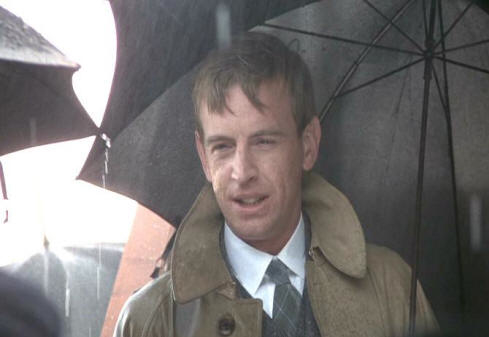
The movie Chariots of Fire tells of the British Olympic team that competed in the 1924 games. Its focus is on two runners, including Eric Liddell – the beloved Scottish soccer star and sprinter and devoted Christian. One of the great scenes occurs early in the movie after a regional track meet in which Liddell has won his race. He is addressing a gathering of spectators in a lightly falling rain. He beautifully elaborates on the analogy between sports and our faith journey. “You came to see a race today. To see someone win. It happened to be me. But I want you to do more than just watch a race. I want you to take part in it. I want to compare faith to running in a race. It’s hard. It requires concentration of will, energy of soul. You experience elation when the winner breaks the tape – especially if you’ve got a bet on it. But how long does that last? You go home. Maybe your dinner’s burnt. Maybe you haven’t got a job. So who am I to say, “Believe, have faith,” in the face of life’s realities? I would like to give you something more permanent, but I can only point the way. I have no formula for winning the race. Everyone runs in her own way, or his own way. And where does the power come from, to see the race to its end? From within. Jesus said, “Behold, the Kingdom of God is within you. If with all your hearts, you truly seek me, you shall ever surely find me.” If you commit yourself to the love of Christ, then that is how you run a straight race.”

S

In Search Of Guidance


IMG_0220

“The way of fools seems right to them, but the wise listen to advice.”           (Proverbs 12:15)

In early July Pat and I traveled to Vancouver Island on the southwestern coast of Canada to pursue her hobby of birding. Rather than simply fly 2500 miles we opted to travel across Canada by train – a 3½ day journey that a number of friends have told us they’ve dreamed about taking someday. The service on the train was terrific and we were enchanted by many glorious sights of our neighbor to the north. It was a time to relax and enjoy the scenic breadth of God’s creation – from the lakes and woods of Ontario, across the Great Plains of Manitoba and Saskatchewan, over the Rocky Mountains of Alberta, to the final dizzying descent through British Columbia to the Pacific Ocean.

Although the train trip was intended to be its own adventure, there was an obvious irony that to go bird watching we first crossed an enormous land where there were certainly thousands if not millions of birds, none of which we observed. Aside from traveling too fast in an enclosed train car, we had no one to guide us. We had no one to whisper, “Listen to that whoo, whoo, whoo – that is the sound of a Great Gray Owl,” or “Do you see that flash of blue – that is a Mountain Bluebird!” As much as we would have welcomed a leisurely walk with an expert, our destination lay elsewhere.

By the time we reached Vancouver Island we were ready to get out and find some birds. No longer rocking along two steel rails, our pace slowed as we prepared for a quiet stroll through field and fen with binoculars in hand. First, however, we rendezvoused with a naturalist whom we earlier had engaged to show us around the area. We couldn’t have had a better guide than Christopher who despite being only twenty-seven had a love for birds as well as a deep knowledge of them that belied his age. It was easy to imagine that we were birding with Dr. Doolittle. When we entered a forest, Christopher would imitate various bird sounds that actually drew birds to us. At times they answered his calls with vocalizations of their own, making it seem as if they were conversing. Under his guidance we saw seventy different species of birds in two days.

Bird watching is a naturally slow-paced and soul-satisfying pursuit. Surrounded by the sounds, smells, and sights of nature, a walk in the woods or stroll on a beach is uniquely restorative – an activity that can be fully enjoyed on one’s own. However, in order to penetrate the cacophony of sounds and movements to find a specific bird in unfamiliar territory, a guide is essential. The longer we walked with Christopher, the more we heard and the more we saw. What seemed at first to be random chirpings became discernable calls. And the slightest motions in old growth forests soon became recognizable forms. Slowly our ears began to hear and our eyes began to see.

Christopher helped us to hear and see what we would have missed without him. He was a true guide. As I have reflected on our time, I realize that guidance is a principle that applies as much to our spiritual lives and relationships as it does in the natural world.

The Bible speaks about idols having ears that don’t hear and eyes that don’t see, and it cautions that people who trust in idols will similarly lack all discernment. (Psalm 115) Spiritual guides can help us see and hear God’s word for us. For example, when the Ethiopian asked Philip to explain a passage in Isaiah, his eyes of understanding were opened (Acts 8:30-31). Without a guide, we are apt to stumble from one experience to another, often not realizing our mistake until it is too late. As Benjamin Franklin put it, “Experience keeps a dear school, but fools will learn in no other.”

Consider the virtue of seeking guidance.

Having relationships with others who can help guide and direct us on our life journey is an important principle of Christian living. The church has a rich history of formal guidance through spiritual directors. While spiritual direction is uncommon in evangelical circles, it is not unknown, for example, http://formedforlife.org. However, whether it is a spiritual director to help us hear God’s voice, a friend whom we meet with regularly, small group, or other form of Christian community, we need encouragement and counsel from other believers and they need us. When we are not intentional about seeking others but forsake meeting with them, we put ourselves at risk – the risk of stumbling, and the risk of setting up idols in our lives that can have devastating consequences.

We Americans have a heritage of rugged individualism, a dream of being self-sufficient, a cultural norm that is often in conflict with the “one another” commands in the Bible. Regrettably many of us Christians live solitary lives – making decisions in private, often based solely on our feelings. Dallas Willard points out the problem with this in Renovation Of The Heart, where he writes, “A great part of the disaster of contemporary life lies in the fact that it is organized around feelings. People nearly always act on their feelings, and think it only right.” To counteract this tendency, deep Christian community can encourage us to look beyond our feelings to see God’s design for our life.

Take childrearing, for example. Who among us has successfully navigated parenting without input from others? Trusting one’s own instincts is fine as far as it goes, but an outsider can often observe dynamics in a relationship or family that those involved are too close to discern. When we make an idol of self-sufficiency in such matters we are heading for disaster. There is much truth to the legal adage, “a person who is their own lawyer has a fool for a client.” The world tells us to “do your own thing,” so we have men and women sacrificing their marriages and families for the sake of a job or a more “satisfying” relationship. The consequences often aren’t fully realized or appreciated until years later. Is there anything more bitter than tears of regret for self-inflicted wounds?

I know a married person who seems willing to abandon spouse and young children for the sake of pursuing a dangerous profession. This is not an economic decision, but one that is based on their feelings – reportedly what is necessary for them to “feel alive.” The children and spouse are paying a dear price for this decision, but the individual seems oblivious. What is clear to those of us on the outside looking in is that this person will eventually grow too old, too weak, and too tired for this profession, at which point there will be no family to return to. That “train” will have left the station – resentments towards the absentee parent will be engrained. Although this person is a Christian, they have sadly forsaken their church community to pursue a reckless and almost certainly futile attempt at fulfillment. And tragically Paul’s caution that we reap what we sow will be proven true once again.

On the other end of the spectrum is a couple like my friend Bill and his wife. Now in their 60’s, they were intentional throughout their marriage to stay connected with other Christians and to seek out the best information on childrearing. Although they are the first to point out mistakes they made along the way, their “train” never got derailed – they were always seeking spiritual and relational guidance, which they gratefully received and applied. For example, Bill tells how very early in his career a mentor at his office counseled him that while many people could do Bill’s job at work, only Bill could be the husband to his wife and father to his children. Advice that he took to heart.

My own experience lies somewhere between the two previous examples. I was not involved in Christian community as a young man and did not take kindly to Pat giving me advice on interpersonal matters. (Actually I didn’t like anyone giving me advice on anything unless I asked.) Gradually, however, I came to see the value of counsel and community and in the past sixteen years have been blessed by friendships that involve exploring ideas and honest sharing of personal struggles. Sometimes all it takes is a question like, “Why are you afraid?” to suggest a course of action. (Some of the best guidance I have received has come in the form of a question.) For example, I was unsettled and nervous in the weeks leading up to the Vancouver Island trip. Several days before we left I met with a group of friends. A brief discussion and prayer settled my soul and allowed me to enter fully and joyfully into the Canadian adventure.

Our spiritual walk is a lot like birding. While there is much that we can learn and enjoy on our own, having a companion or two enriches the experience. And whether or not they are an expert, our journey through life like a walk through the woods is better with someone at our side.

S

An Unhurried Life

cropped-dscf4239.jpg

Summing up: Be agreeable, be sympathetic, be loving, be compassionate, be humble.  (1 Peter 3:8)

Several weeks ago in the church lobby I was greeted by an acquaintance with, “How’s your family?” I assumed this was a question, but as I started to respond he turned away to speak to someone else. I have known this man for many years and this is typical – he is always in motion rushing from one person to another, like a humming bird frantically darting from one flower to the next. I found the interchange disheartening and socially awkward.

Ironically, it was only a few minutes later that I was hurrying to connect with a friend and I turned away from another person who wanted to speak to me. Talk about hypocrisy! Fortunately, the Holy Spirit was present to convict me. I have become so habituated to my own hurriedness that I have lost touch with the degree to which I ignore and/or avoid contact with other people.

This is not new. When I was working, it seemed natural to be in a hurry – rushing to my job, avoiding co-workers to complete my work, speeding through a daily workout, reading or listening to the radio when family members tried to communicate. Even in retirement the old habits of hurrying are still with me. I rush to get my breakfast and cleanup the kitchen every morning. I watch the clock when I am exercising and do not like being interrupted during my routines. When I am on the road, I want to pass anyone not going at least 5 mph over the limit, and am frustrated when stuck behind someone driving slow. But mostly I am too hurried to be fully present with other people. I live a hurried life.

A hurried life is not the same as a busy life. Being busy is an external circumstance based on mental “to do” lists. Having things to do is part of the human condition – the “work” that God assigned to Adam and the work we all do as part of living. On the other hand, being hurried, is an internal state that focuses principally on my agenda and my needs. John Ortberg in Soul Keeping describes it this way. “Being busy is an outward condition, a condition of the body. It occurs when we have many things to do. Busyness is inevitable in modern culture. … [In contrast] Being hurried is an inner condition, a condition of the soul. It means to be so preoccupied with myself and my life that I am unable to be fully present with God, with myself, and with other people. I am unable to occupy the present moment. Busyness migrates to hurry when we let it squeeze God out of our lives.”

The roots of being hurried go deep in my life, showing up in the ways that I interact with other people. I have a framework for my day, which fundamentally is built around me. I don’t enjoy interruptions such as phone calls or emails or conversations that I have not initiated. And it turns out that I am not alone. In Transformed Into Fire Judith Hougen writes, “My whole life I have been complaining that my work was constantly interrupted, until I discovered that my interruptions were my work.” Her words cut to the heart of the matter by describing the fundamental mind-shift essential to embracing an unhurried life. Namely, interruptions are not a problem to be avoided, but a ministry to be embraced. Reflecting on this, I have to admit that I often see other people more as irritations than those I am called to love. It is a profound revelation about how I choose to relate to others, and not one I am proud of.

Hougen goes on to describe a relevant spiritual discipline, which she refers to as mindful availability. “Mindful availability is a focused openness to the other, born of our attentiveness to God’s presence in the present moment. You welcome others into the loving, ego-less space God creates within you for true self ministry. Simple as it sounds, your full, compassionate, worshipful attention is one of the greatest gifts you can ever offer. Mindful availability is a spiritual practice that enables us to see all of life as a sacrament.” Mindful availability is a spiritual discipline leading to an unhurried life. For me, it means taking time to listen to others who come into my path.

After being been chastised by the Holy Spirit as to my hypocrisy at church, I resolved last week to practice the discipline of mindful availability at home. My plan was simply to be attentive when Pat is talking to me. I quickly discovered that I have a number of unpleasant if not rude habits in our relationship. For example, I often do not look at her when she is talking. She might come into a room where I am working on the computer and ask me a question, and I respond without looking up. Sometimes I do not hear what she is saying because I am too involved in my work to focus on her. And there are still other times when I actually walk out of the room when she is talking. Undoubtedly some of this is born of the easy familiarity that comes with a good marriage. Unfortunately though some of my bad habits are simply a matter of poor manners – I obviously missed a few days of Kindergarten where they talked about being “a good listener.” The deeper reason is no doubt my pride and a soul preoccupied with itself – a hurried soul.

Paul tells us “love is patient” (1 Cor. 13:4) I have always understood “patience” to mean longsuffering or slow to anger. In other words, “putting up with” or tolerating another person. While patience clearly has this meaning, the Greek word for patience, makrothymeō, is also translated “to be of a long spirit.” Taken in this sense, I am wondering whether patience is not only reactive (putting up with), but also proactive, such as stretching our spirit to be attentive and present to another person? If so, true patience is found an unhurried life.

What do you think?

S

Guard Your Heart

Above all else, guard your heart, it is the wellspring of life. (Proverbs 4:23)

Pat and I spent an evening with a group of believers last week. Our conversation covered a wide range of subjects, and although our words towards one another were gracious and warmhearted, the overall tenor of the discourse was decidedly negative as it moved from one gloomy, if not cynical, topic to another. Presidential politics, bureaucratic incompetence, moral decay, and immigration were just some of the things that came up.   Although much that was said was no doubt true, the many critical words spoken weighed heavily on my spirit.

As I thought about the conversation afterwards, I recalled a short reflection on critical words I read about ten years ago. Taken from Catherine Marshall’s prayer journal, the piece is entitled simply “A Fasting on Criticalness.” In it she tells how the Lord told her to fast from “criticizing anybody about anything” for one day. Her description of the “fast” is instructive if not humorous.

“For the first half of the day, I simply felt a void, almost as if I had been wiped out as a person. This was especially true at lunch with my husband, Len, my son, Jeff, and my secretary present. Several topics came up (school prayer, abortion, the ERA amendment) about which I had definite opinions. I listened to the others and kept silent. Barbed comments on the tip of my tongue about certain world leaders were suppressed. In our talkative family no one seemed to notice. Bemused, I noticed that my comments were not missed. The federal government, the judicial system, and the institutional church could apparently get along fine without my penetrating observations. But still I didn’t see what this fast on criticism was accomplishing – until mid-afternoon.”

She goes on to describe how the Lord revealed to her the extent of her critical nature and how it had accomplished nothing during her life. To the contrary, it had actually crippled her creativity – in prayer, in relationships, and writing.

After reading this account I tried following her experiment myself one Saturday, expecting it to be a breeze. [Confession – I selected a Saturday because during the week I supervised others at work. Obviously they needed to be criticized!] I had barely started my breakfast when I realized I had already had three critical thoughts – one concerning my neighbor who hadn’t cut his lawn that week (the jerk), one about a political matter being reported on the radio, and another about a family member. Talk about the Holy Spirit hitting me on the head with a two-by-four! There was no doubt that my critical spirit was deeply rooted.

Over the past decade I have from time to time returned to Catherine Marshall’s experiment – sometimes for a day, sometimes as long as a week. As I have practiced abstaining from criticism, I have observed subtle changes in my thought processes. While my habit of being critical of others has not been broken, I have become more aware of the times when I am being critical and am generally more sensitive to negativity. I think this is why I felt unsettled in my spirit when we were with the group last week. I felt no self-righteousness – more a feeling of unsettledness, like losing my equilibrium with nowhere to sit.

For me, fasting from criticalness has been a practical way of guarding my heart. I believe this is what Paul means when he says to “take captive every thought to make it obedient to Christ.” (2 Cor. 10:5). I have found this easier to do when I focus on positive thoughts, such as making charitable judgments when I am tempted to be critical. Again, Paul wisely writes, “Finally, brothers and sisters, whatever is true, whatever is noble, whatever is right, whatever is pure, whatever is lovely, whatever is admirable – if anything is excellent or praiseworthy – think about such things. Whatever you have learned or received or heard from me, or seen in me – put it into practice. And the God of peace will be with you.” (Phil. 4:8-9)

I have a friend who rarely speaks a critical word about others. Although he has had his share of heartbreak and challenges, they have not defined him or his view towards others. When he talks about his life it is always from the perspective of deep gratitude to God and how fortunate and blessed he has been. He guards his heart by focusing on the kindness that others have shown to him. And he sees his service to others as simply following the direction of the Lord. While he is not blind to the troubles of our world and will speak about them when pressed, they do not command his attention. His focus, hope, and strength is in the Lord. He is like those spoken of by the prophet Isaiah. “Those who hope in the Lord will renew their strength. They will soar on wings like eagles; they will run and not grow weary, they will walk and not be faint.” (Isaiah 40:31)

Oh for the strength to guard my heart today.

S

Rooted In Christ

IMG_1738

“There is a river known as joy that flows through streets of gold, it brings the city of our God delight and bliss untold.” (Psalm 46:4)

A little stream flows behind our house. On warm mornings while it is still dark I open a window on the sun porch and listen to the waters splashing down over the rocks. The soft sounds from this babbling brook sooth my soul. I turn on some quiet worship music and am drawn into a deeper meditation during my daily devotional – the solitude being broken only by the occasional calls of geese, ducks, or other birds that make their home along the banks.

The waters of this little stream are not only soul-soothing, but life-giving. Trees and bushes planted along the channel thrive even in the driest months of the year, providing shelter and sustenance for the local wildlife. A song sparrow has safely taken up residence in one large Mugo pine as it has for the past several years. Rabbits hide in the low evergreens. A coyote is occasionally seen trotting alongside the embankment and a fawn was once spotted nestled down in the grasses on the far side. Mother ducks move freely up and down the channel with their brood of chicks loosely in tow. The words of Psalm 104 capture the scene well.

10 O Lord, You make the bounding springs whose waters ever flow, Between the mountains and the hills to valleys far below.

11 The waters quench the thirst of mules and beasts within the field; While animals on riverbanks drink freely from their yield.

12 The birds are safe in trees that thrive where rivers rush along; They nest among the verdant leaves and sing a happy song.

These words speak to the great gift of life that comes from God, and to how the Lord has arranged the natural world around water. It is water, we are told by astrobiologists, that signals the potential for life on other planets. Nothing cheers the celestial mind like the promise of finding water, even ice crystals, on distant planets. Whether or not God has created life on other planets we may never discover, but without water, life on earth as we know it would not exist. Since ancient times, communities and civilizations have always sprung up around a source of water. When Moses led the Israelites through the desert, water from the rocks was miraculously provided by God to sustain their lives. In our own country’s great westward migration, access to water was fundamental. Towns were always planted around a water source – be it a river, lake, or natural springs.

This most basic need for water, the building block of life, is no doubt why Biblical metaphors about water are so rich. From Isaiah’s invitation “Come, all you who are thirsty, come to the waters … .” (Isaiah 55:1), to that of Jesus Let anyone who is thirsty come to me and drink. Whoever believes in me, as Scripture has said, rivers of living water will flow from within them.” (John 7:37-38) – the imagery of water captures the imagination. And of course the meaning is clear, we need to remain close to the source in order to live.

I write this month, not about a specific virtue per se, but rather about the power of metaphor to encourage a life of virtue in the kingdom of God.

I started thinking about this several weeks ago when a friend described how he avoids brooding over disappointments and hurts in his life. Whenever a worry arises, he visualizes it as a leaf in a stream that he observes from the bank. As the current carries the leaf from his view, he allows the concern to pass from his mind. The metaphor helps him to take his thoughts captive and dwell on what is true and right. Modern science has finally caught up with this ancient Biblical wisdom as it has come to understand the power of our thoughts to impact things like our heart health, blood pressure, etc. That said, Biblical metaphors are more than visualization triggers with health benefits – they are windows into spiritual truths that can help us re-vision our world and draw us closer to God.

I believe this is why metaphors are so widely used in Scripture. Jesus, for example, speaks of building a house on a rock, being salt and light, sowing good seeds into good soil, and abiding as a branch to a vine. Indeed, most of Jesus’ teaching on the kingdom of God involves the use of metaphors – fields and seeds, treasure and pearls, etc. – all to capture our imagination in envisioning his kingdom. The Old Testament writers also use many metaphors – most involving “water,” such as springs, well-watered gardens, fountains, etc.

My favorite metaphor in all of Scripture is that of a tree planted near a stream of water, described in Psalm 1.

How blessed is the man who does not walk in the counsel of the wicked, nor stand in the path of sinners, nor sit in the seat of scoffers! But his delight is in the law of the Lord, and in His law he meditates day and night. He will be like a tree firmly planted by streams of water, which yields its fruit in its season and its leaf does not wither; and in whatever he does, he prospers. The wicked are not so, but they are like chaff which the wind drives away. (Psalm 1:1-4)

There is no more compelling image of Christian virtue than this. By making the hard choices to reject ungodly thoughts, sinful actions, and hurtful words, and choosing instead to be immersed in God’s Word, the Lord’s promise is one of blessing. Metaphorically, the promise is that of prospering like a tree that is deeply rooted near a stream of water. This type of life is not automatic, it requires a decision to live a life of virtue. But once resolved to follow God’s word, a measurably better life will result. Not a life without trouble to be sure, but ultimately one with victory. I imagine a tree surviving searing droughts of summer and remaining verdant and fruitful while other trees are losing their leaves and dying. Storms may blow through and knock off the odd branch or two, but its trunk is supple and able to bend before great winds without breaking or being uprooted. Its “secret” is being firmly connected to the channel from which it draws life.

This I believe is what Jesus meant when he explained to the woman at the well that he is the source of living water. “Everyone who drinks this water will be thirsty again, but whoever drinks the water I give them will never thirst. Indeed, the water I give them will become in them a spring of water welling up to eternal life.” (John 4:13-14) In much the same way that a vine channels water to its branches, the stream provides water to roots that are tapped into it.

Yes, the little stream that runs behind our house is a delight, the bushes and trees planted by its banks lovely, and the various birds and animals that drink of its waters a constant source of wonder and amusement. Yet on the high banks above our stream, we have a lawn that is dying. It is close to the stream, but not close enough – the soil is hard and the distance from the stream too great. There are times when I feel as dry and withered as my lawn – tired, beat down, depressed. When I do, I find that reflecting on a tree rooted near a stream is a powerful image of hope and strength that encourages me to hold close to the source of living water.

And what a joy to know that by staying rooted in Christ, one day the metaphor of the tree will become reality when beholding the new heaven and new earth, as revealed to John.

Then the angel showed me the river of the water of life, as clear as crystal, flowing from the throne of God and of the Lamb down the middle of the great street of the city. On each side of the river stood the tree of life, bearing twelve crops of fruit, yielding its fruit every month.  (Rev 22:1-2)

What keeps you rooted in the Lord?

S

Civility

Do not let any unwholesome talk come out of your mouths, but only what is helpful for building others up according to their needs, that it may benefit those who listen. (Ephesians 4:29)

An octogenarian threatened me with a caning last month.

Pat and I were visiting her mom in an assisted living facility in Maryland when I noticed an elderly gentleman walking in our direction on a strip of lawn rather than the sidewalk. When I asked whether he had once lived on a farm his countenance immediately brightened as he confirmed my observation. Discussing our roots, I mentioned that we were from Ohio, and he asked whether I was going to vote in the upcoming Republican primary in my state. Before I could answer he asserted that “Trump is the best man for the country,” and then added that if I didn’t vote for Trump, the next time we met he would “hit with his cane.” His comment was amusing but also distressing given the day’s news about violence at Trump rallies. And regrettably, I responded with a flippant comment about the candidate’s vulgarity.

This got me to thinking about what Christian virtue looks like in the toxic political environment of an election year. What standards should we expect of ourselves, and for that matter of a candidate for public office who holds himself or herself out as a Christian? To the latter point, Max Lucado has a courageous blog post, entitled “Decency for President,” in which he challenges Mr. Trump on his crudeness, name-calling, and general behavior antithetical to the Christian faith he professes. https://maxlucado.com/decency-for-president/

But the real takeaway for me from the exchange with the elderly gentleman was to remember the standard that the Lord expects of me – a standard that I missed when I responded impulsively to the old man’s words.

Ironically, I have been troubled for years about the shameful discourse among many Christians when discussing politics. Our Master tells us to love one another, even our enemies. He challenges us against our anger and confronts us against the damage our tongue causes, yet many who claim to follow Christ freely express the most scathing and vitriolic comments about those with different political beliefs.

Consider then the virtue of Civility, which refers to politeness and courtesy in behavior and speech.

In its early usage, the term civility referred to being a good citizen with orderly behavior. I suppose this is why civility seems to be used more in a public sense, referring to our proper role as citizens. Alas, though, I fear the word has become hijacked in recent years by its association with “political correctness.” The latter phrase being almost exclusively used in a pejorative sense. This is too bad because the best meaning of political correctness is simply showing a sensitivity and kindness toward others, which we Christians should always do. Does anyone believe that mocking someone who has a disability or publicly commenting on someone’s bodily functions is honoring to God? Paul was unequivocal when he said to “have nothing to do with people [who are boastful, proud, abusive, … unholy, without love, unforgiving, slanderous, without self-control, brutal, not lovers of the good, treacherous, rash, conceited, etc.]” (2 Timothy 3:1-5)

Let’s be honest, Civility is a pretty low bar when it comes to Christian virtues. For the most part, civility is simply abstaining from hurtful or vulgar remarks. In other words, as Paul counsels, to “not let any unwholesome talk come out of your mouth.” We don’t need sensitivity training to do this. We simply need to be sensitive to others and to exercise charitable judgments toward them. We are nowhere near the rarefied heights of Christian love where words of affirmation, understanding, and compassion dwell.   No, we are talking about the lowlands of ordinary human discourse accessible to all through God’s common grace.

Jesus stated that it is out of the overflow of the heart that the mouth speaks, and so I take full responsibility for the words I speak. It is no excuse to blame my speech on the candidates or the political climate. The root of my problem, as I see it, is that I have allowed my heart to be poisoned by the rhetoric from the campaign. I have not heeded the wisdom of Scripture – “Above all else, guard your heart, for everything you do flows from it.” (Proverbs 4:23)

And thus, this political season, I am determined to guard my heart, to not be swayed by the voices of the ungodly – whether candidates or ordinary citizens. The challenge for me is not to sit passively in conversations where unforgiving and slanderous remarks are expressed, or worse, allow myself to be drawn into such discussions. Being mindful of Jesus’ caution – that it is what “comes out of the mouth that makes one unclean,” I would rather emulate the wisdom of Scripture, “Gracious words are a honeycomb, sweet to the soul and healing to the bones.” (Proverbs 16:24)

A wise friend once told me that early in his marriage he and his wife agreed that words spoken to one another would always be “kind, necessary, and true.” This is certainly good, practical advice to heed in all discourse. Hopefully next time I am threatened by an octogenarian I will remember this.

S

Encouragement

One of the saddest memories I have from childhood involves a family we occasionally visited. While I recall many good times playing with the children, I cannot shake the image of a stern father who expected his boys to operate within narrow boundaries – any deviation of which was met with condemnation and punishment. It seemed to me that his standards were arbitrary and unattainable, particularly for two young boys. For example, if one of them mowed the lawn it was never good enough – the critical eye of the father always found the blade of grass that was missed. As years passed the boys struggled in both their professional and private lives.

Now I want to be careful in judging the lives of the boys as they grew into men, because many people have trouble holding down a job and/or end up with broken marriages. Caution too must be taken in drawing an inference between the father’s words and the lives lived out by the boys – every individual bears ultimate responsibility for the life he or she lives. Strengthened by the Holy Spirit, one’s past need not determine one’s future. Nonetheless, our reclamation is made much harder by destructive words and actions – particularly those from a parent to a child. The word of the Lord is that “He visits the sins of the fathers upon the children to the third and fourth generations.” (Numbers 14:18) Not, I suppose, because God is vengeful, but because the sin of one person can inflict wounds and establish patterns of destructive behavior that can endure for generations.

Consider now the virtue of Encouragement.

In their excellent book entitled Encouragement, Larry Crabb & Dan Allender define encouragement as “the kind of expression that helps someone want to be a better Christian, even when life is rough.” This I think is a wonderful goal – wanting to be a better Christian. Encouragement should flow naturally from our Christian community as we “consider how to stir up one another to love and good works, not neglecting to meet together, as is the habit of some, but encouraging one another … .” (Hebrews 10:24-25) What a lovely ministry to stir up in another person love and good works.

I believe that encouragement is a fundamental human need – one with roots that are deeper than our desire to live a better life, as critical as that is. I say this because the roughest times in my life, such as when I underwent open heart surgery, have been more about my feelings of being alone than the circumstances of my operation. Feelings that we are alone, or perhaps unloved or unwanted are a lie of the enemy. We know this because God has said “never will I leave you; never will I forsake you.” Encouragement then addresses this need by letting a person know they are valued. Thus, I would define Encouragement as: “the kind of expression that makes someone feel valued.”

So what does it take to be an encourager? Part of the thought process here is simply thinking about the people and times we were most encouraged in our own lives. I submit that there are two qualities of an encourager, which involve both the heart and mind – namely, sincerity and appropriateness.

Regarding sincerity, the heart of an encourager is genuinely interested in and values another person. A wonderful Christian couple I know have modeled this over the years by simply being curious about others. They are aware of those around them and initiate conversations. They ask lots of questions and are interested in the answers. They are emotionally present. When I am with them for any length of time I tend to feel better about myself, better about them, and better about interacting with others – in short, I feel encouraged. Sincere interest in another person sends a powerful message that such person is valued. Perhaps this is the reason Paul exhorts us to, “Do nothing out of selfish ambition or vain conceit. Rather, in humility value others above yourselves, not looking to your own interests but each of you to the interests of the others.” (Philippians 2:2-4) If we value others above ourselves we will naturally show a sincere interest in them.

Regarding appropriateness, the mind of an encourager is sensitive to what is appropriate for a given situation. As with other matters of the mind, knowledge is vital. I recall a time at work when a colleague lost her daughter in a tragic automobile accident. Our employer brought in a grief counselor who gave us a number of helpful guidelines. For example, we were advised that telling the woman that her daughter “is in a better place,” would likely not be received well by the woman and there were better ways for us to express our sympathy in the immediate aftermath of the tragedy. Paul’s urging to be “transformed by the renewing of your mind,” (Romans 12:2) is a great reminder that we need to think through the best way to be an encourager in a given situation. Although there are no formulas to follow, there are principles to practice.

While every Christian virtue impacts those around us, there are few as directly impacting as encouragement. Conversely, there is none more deadly than discouragement. As we are told in Scripture, “Words kill, words give life; they’re either poison or fruit – you choose.” (Proverbs 18:12) (Message) A clearer and more concise statement you will not find.

After half a century, I still grieve the experience of the family from my youth. I pity the father who himself had no model of a loving father. I mourn the sons who struggled with the wounds they received. I am saddened by new wounds that are visited upon the next generation. And yet I can rejoice that One has come with the power to turn “the hearts of the parents to their children and the hearts of the children to their parents.” (Malachi 4:6) Jesus saves us so that words spoken to us need not determine the course of our life. And He heals us so that we can speak words of life to others.

Who will you encourage today?

S

Simplicity


IMG_0293

“Do not store up for yourselves treasures on earth, where moths and vermin destroy, and where thieves break in and steal.” (Matthew 6:19)

“Rare bird alert!” Pat could barely contain her excitement as she announced these words early one morning. Social media for Ohio birders was chirping with the news that a Le Conte’s sparrow had been sighted in a swampy field some thirty miles to the south. In a birding culture that thinks nothing of driving across the state on a moment’s notice to see an uncommon bird, this was like having it in our backyard. And thus a few hours later we found ourselves trudging across a wet field on a vague tire track of a path to find and study this wayward sparrow. Our “hunt” was successful and after several fine minutes of watching it through our binoculars we retreated to the car for the drive home. The bird was colorful, the weather fair, and the search exciting so all in all it was a lovely time.

Lovely, that is, until we returned to the car and discovered scores of “hitchhiker” seeds from the field had attached themselves to our pants and socks. These were not a few stray pieces of dead grass that clung to us, but seeds of a much more tenacious sort. The kind with invisible curved barbs that burrow into clothing for a long-term relationship. The kind that cling to their host with a seriousness of purpose that seems to defy conventions of the natural world. These seeds do not take kindly to being removed, requiring minor surgery as one by one they must be extracted from the fabric. Even then, if they are casually thrown to the wind, they often turn in their free fall as if by some magical force and swoop back for an encore visit.

Upon reflection, I am struck by the similarity of these hitchhiker seeds to our stuff. Now by “stuff” I am referring to stuff. You know, artwork and decorations on walls, clothing in closets, tools in the garage, books on shelves, kitchenware in cabinets, knickknacks on bureaus, electronic gadgets just about everywhere, and piles of papers crammed into desk drawers, boxes, file cabinets, and wherever. When I look around at all of the stuff I have accumulated, I am about as surprised as when I discover an army of hitchhiker seeds on my socks after walking through a field. Where has it all come from? I really can’t say. And getting rid of it – well, this is much harder than removing several dozen hitchhiker seeds.

To be clear, I am not talking about a few selected items of personal history, but a crush of goods cleverly concealed to create the illusion of order and control. For in reality, what is visible in our homes is often a deceptive fraction of our possessions – the bulk of which are hidden up in attics and down in basements, on top of shelves and under beds, behind doors and inside drawers, hanging in garage cabinets and tucked into tool sheds – wherever there is space we have stuff to fill it. And as often as not we run out of the former before the latter. Indeed, we Americans have so much stuff that our houses are not big enough to hold it. For relief we have turned to self-storage units, and in a big way. Estimates are that there is roughly 2.5 billion square feet of self-storage in the United States – the equivalent to about a hundred square miles. That’s room for a lot of stuff! For the truth is we are a nation of hoarders.

And so this month consider the virtue of simplicity.

At the outset I confess to being undecided whether or not simplicity is a virtue. Certainly Jesus words seem clear enough, “Do not store up for yourselves treasures on earth, where moths and vermin destroy, and where thieves break in and steal. But store up for yourselves treasures in heaven.” (Matthew 6:19-20) Jesus also tells a parable about a rich fool who builds more barns to store his stuff, “But God said to him, ‘You fool! This very night your life will be demanded from you. Then who will get what you have prepared for yourself?’ This is how it will be with whoever stores up things for themselves but is not rich toward God.” (Luke 12:20-21).

In Christian tradition simplicity is a spiritual discipline – something that is practiced to help free us from worldly entanglements that impede our inward growth. But is it a virtue? In other words, is simplicity an end in itself – a behavior that is inherently good and right from God’s perspective? For example, does God care whether I have a closet with clothes I never wear? Does He mind whether I have shelves of books I never read? Does it matter to Him if I have tools I haven’t touched in years?

For me, these questions are rhetorical – I hear God’s call to simplify. And this brings me to the crux of the matter, which is how to reorder my life and possessions to bring them into line with God’s will. This is a big undertaking – the deacquisitioning of my stuff. But it is a job that will eventually fall to someone someday, if only in one final estate sale, trip to Goodwill, and/or the dump. And perhaps the final impetus I need to simplify my life is knowing my stuff is potentially a burden for my children.

For others of you, the matter may not be settled – God may not be speaking into this area of your life. He may well be more interested in other aspects of your spiritual growth. In which case, I think it would be wrong to devote efforts to simplifying your life at this time. The question for all of us Christians is whether we are seeking first the kingdom of God, or whether we are being distracted by time and energy being put into acquisition, maintenance, and security of our stuff? If our things are inhibiting our spiritual growth, then perhaps we should start paring down.

For me, simplicity is a desirable state, but I am cautious not to overstate its importance. In Celebration of Discipline, Richard Foster warns about the danger of the discipline of simplicity by stating, “Of all the disciplines, simplicity is the most visible and therefore the most subject to corruption.” As he says, the key is always to seek first the kingdom of God. In so doing we are seeking three inner attitudes: 1) to receive everything we have as a gift; 2) to allow God to care for all we have; and 3) to make what we have available to others. When we cultivate these attitudes the outward behavior of simplicity will follow.

The LeConte’s sparrow is small with an orange face and dark streaks on its otherwise yellowish sides and flanks. It is subtly beautiful, but rare to see even in its normal haunts because of its shy and retiring nature. I wonder that simplicity in the present age may well be as rare as this elusive and colorful little sparrow. That said, I have no doubt that living simply is no less beautiful to God because of these words of Jesus, “Is not life more than food, and the body more than clothes? Look at the birds of the air; they do not sow or reap or store away in barns, and yet your heavenly Father feeds them. Are you not much more valuable than they?” (Matthew 6:25-26)

Let me know what you think.

S

In Search Of Goodness

My soul was jarred by the morning news early last week. The cumulative impact of one distressing story after another. North Korea claiming to have a hydrogen bomb and submarines to launch it, a disaffected group occupying a Federal building in Oregon, a leading presidential candidate dispensing his unique form of vitriol on the campaign trail, ISIS announcing a new UK man as its executioner and spokesman, and these were just the headlines. Meanwhile, the national debate over immigration, gun control, and healthcare is as intractable and nasty as ever.

At times like this I question whether listening to the news is the best way to start a day. Either my heart bears the burden of these stories or it becomes hardened to them. On this particular morning my spirit felt more burdened than hardened when I sat down for my quiet time. Goodness seemed eclipsed by the darkness of my thoughts, which were well captured by the refrain rattling around my brain – “And in despair I bowed my head; ‘There is no peace on earth,’ I said; ‘For hate is strong, and mocks the song of peace on earth, good-will to men!’” These words, of course, are from the song I Heard The Bells On Christmas Day, based on the poem Christmas Bells by Henry Wadsworth Longfellow.

There is a way of living that can impede our search for goodness. For ours is an unfortunate age that feeds on fear. It’s not just the fear of terrorism and its perceived threat that grips our collective hearts, but the fear of a weakening economy and losing one’s job, the fear of a changing environment from global warming, the fear of illness from drug-resistant superbugs, etc. The fires of these fears are stoked by “talking heads” in the media forever blaming a person or political party for all of our ills, real or imagined. If only we would put their man or woman in office all would be well.

The question I struggled with on this particular morning was not just how to transcend the bleakness of the morning news, but where to find goodness in a world of evil? Where to rest a soul hungering and thirsting for goodness? Where to find things that are true, noble, and right? Where to seek what’s pure, lovely, and admirable?

I discovered goodness in two places that day. First, in a delightful book I am reading called Northern Farm written by Henry Beston in the 1940’s. This is a journal of a year in the life of a Maine farm. Mostly it is a reflection about nature and the seasonal changes in one rural outpost Downeast. The author’s reflections remind me of the rhythm of life lived close to the land – a slower paced, more deliberate existence in harmony with rather that opposition to the natural (and supernatural) world. Within a few pages I felt my spiritual equilibrium being restored. But beyond the narrative is the fact that my Father loved to read this book, which was his copy that he gave me a year or so before he died. So when I hold and read it I am also remembering my Dad and imagine him being filled by the beauty of the images sketched by the author.

I also found goodness in a memorial service I attended later that day for the mother of a friend of mine. Her name was Millie and the tributes to her were lovely, with many members of her extended family eulogizing her. One thing that stands out for me was how open and accepting she was to people in her life. Particularly moving was the way the spouse of each of her children recounted how she embraced them unconditionally and became for them a second mother. Loving others like this is truly the heart of goodness.

Both the book and memorial service were a balm for my soul. They encouraged me to think anew about goodness and what it means to live a good life.

Longfellow’s poem doesn’t end in despair despite the fact that when he wrote it on Christmas day 1863 he had good reason to despair. The nation was engulfed in the great Civil War, his oldest son lay in a hospital bed paralyzed by a bullet from that war, and he was still mourning his wife who had died tragically two years earlier when her dress caught fire. That Longfellow had five other children to care for certainly weighed heavily on his heart. How deep his despair must have been when he penned the verse of no peace on earth, no good-will among men.

And yet, somewhere Longfellow found the strength to transcend this dark period of his life as his concluding words express a deeper hope and reality, “Then pealed the bells more loud and deep: ‘God is not dead, nor doth He sleep; The Wrong shall fail, The Right prevail, with peace on earth, good-will to men.’” Great words of faith to hold onto as a certain reality. And a great encouragement in the search for goodness.

S

Goodness


       “What shall I return to the Lord for all his goodness to me?”  (Psalm 116:12)

The rain ended sometime in the middle of the night. I have a vague recollection of hearing one final shower on the south facing bedroom windows before dropping off. In the morning the rain gauge reported the final storm tally – over five inches. Normally by this time of year the gauge would be safely stowed indoors in its “winter quarters.” However, record-breaking warm weather and the curiosity of quantifying the coming deluge brought it out of hibernation for a few days. What was a major late December weather maker for us, brought tornados and devastation to less fortunate parts of the country. The result, we are told, of a super El Niño in the Pacific this year. Our local rivers are at flood stage and it will be several days before they once again run inside their assigned channels. The wind is now banking from the west and temperatures are dropping to more normal levels – just in time for the New Year.

To my mind, there is something essential about cold temperatures and short days to make it feel like the end of one year and the start of the next. How strange it would be to live in more temperate regions of the world, not to mention the Southern Hemisphere where the New Year coincides with the start of summer. For me, though, it is cold and darkness that mark the turning of the year – a few brief days after the astronomical timing of the winter solstice, when the north pole of earth’s axis makes an imperceptible yet decisive pivot back towards the sun.

And so as the calendar year makes its turn in this bleak midwinter, my thoughts about a “Year of Virtue” pivot from last year’s journey to the next. I have in mind many more virtues to explore as a way of seeking first the kingdom of God and His righteousness. Hopefully, many of you who participated last year will continue to engage in this ongoing experiment of intentionally following Jesus. Perhaps others will join us. For me, the past year has been greatly enriched by our fellowship and mutual encouragement.

For the start of the New Year, I have been thinking about goodness and what this looks like for a follower of Jesus. The Old Testament refers to goodness almost exclusively in reference to a key attribute of God. For example I remain confident of this: I will see the goodness of the Lord in the land of the living.” (Psalm 27:13); and “What shall I return to the Lord for all his goodness to me?” (Psalm 116:12); and notably, “Surely your goodness and love will follow me all the days of my life, and I will dwell in the house of the Lord forever.” (Psalm 23:6) God, of course, looked at the whole of His creation and declared it good – the earth, the seas, the creatures, and man. Much was lost by the Fall, yet Jesus has redeemed us so that we can recover some of His goodness in our lives.

Perhaps this is why the New Testament insists that goodness is a key virtue in the life a follower of Christ. It confirms that we are called to live a godly life by the goodness of God (2 Peter 1:3) Paul’s prayer for the Thessalonians is that God will bring to fruition their desires for goodness. (2 Thessalonians 1:22). And while we know that goodness is a fruit of the Spirit (Galatians 5:22), it is significant that Peter tells us that we are to make every effort to add goodness to our faith. (2 Peter 1:5)

Trying to define goodness is difficult without using the word good or a synonym. Perhaps this is why it is not easy to discuss goodness in the abstract. A key point I think is that goodness involves right thought and action and avoiding its opposite, evil. A description of goodness that captures these ideas is:

“In man is not a mere passive quality, but the deliberate preference of right to wrong, the firm and persistent resistance of all moral evil, and the choosing and following of all moral good.” (Easton’s 1897 Bible Dictionary)

Looking at the list of virtues we explored in 2015, there are elements of goodness in all of them – joy, patience, generosity, self-control, courage, kindness, peace, humility, faithfulness, justice, thankfulness, and compassion. All of which suggests to me that goodness is foundational to our Christian walk and thus important to consider how to “make every effort” in pursuing it. It also introduces a note of caution for me insofar as the very depth and breadth of this virtue of goodness may make it harder to grab hold of in a practical way.

I write from my experience last year in which the virtues I found most impactful were those such as patience, self-control, and thankfulness, which I was able to practice in concrete ways. Ones that I thought about in more abstract terms such as courage and justice were harder to engage with. Thus, a goal for me in the New Year is to pursue each virtue in a tangible way. In other words, become a doer and not just a hearer.

I am thinking about three specific ways to embrace goodness. First, I need to interject goodness into the tangled relationships I have with certain family members by resetting the way I interact with them. In some instances it involves contacting them more often, for others it is making charitable judgments for their actions, for all it will involve praying for them.

Second, because goodness also involves turning from sin, I am trying to be honest with God and myself by looking deeply at specific areas of my life where I am not living a life worthy of the calling I have been given. Paul imparts some wonderful wisdom on this in Ephesians 4. My focus will be on Ephesians 4:29, “Do not let any unwholesome talk come out of your mouths, but only what is helpful for building others up according to their needs, that it may benefit those who listen.”

And third, I believe that goodness isn’t just doing, it also involves receiving. And here I want to meditate on the goodness of God’s creation. The heavens show the work of God, His glory they proclaim; the skies disclose His handiwork through starry host aflame.” (Psalm 19:1) Even in the midst of unusual weather events, which are certain to occur in the coming year, I want to marvel at the goodness of God and how he renews creation just as He wants to renew me. Which brings me back to the question of the Psalmist “What shall I return to the Lord for all his goodness to me?” (116:12)

So what does goodness mean to you? Where does this fit within your understanding of Christian virtue? Where do you need to exemplify goodness in your life? How do you “make every effort” to add goodness to your faith? Your comments are most welcome.

God bless you all in the New Year.

S