“The light of day is beautiful, and sweet to look upon; It’s pleasant for the eyes to see the wonder of the sun.”
(Ecclesiastes 11:7)
This is the eleventh post on Ecclesiastes, which I am translating into common meter. The following contains my rendering of Ecclesiastes 11, preceded by a brief reflection.
**********
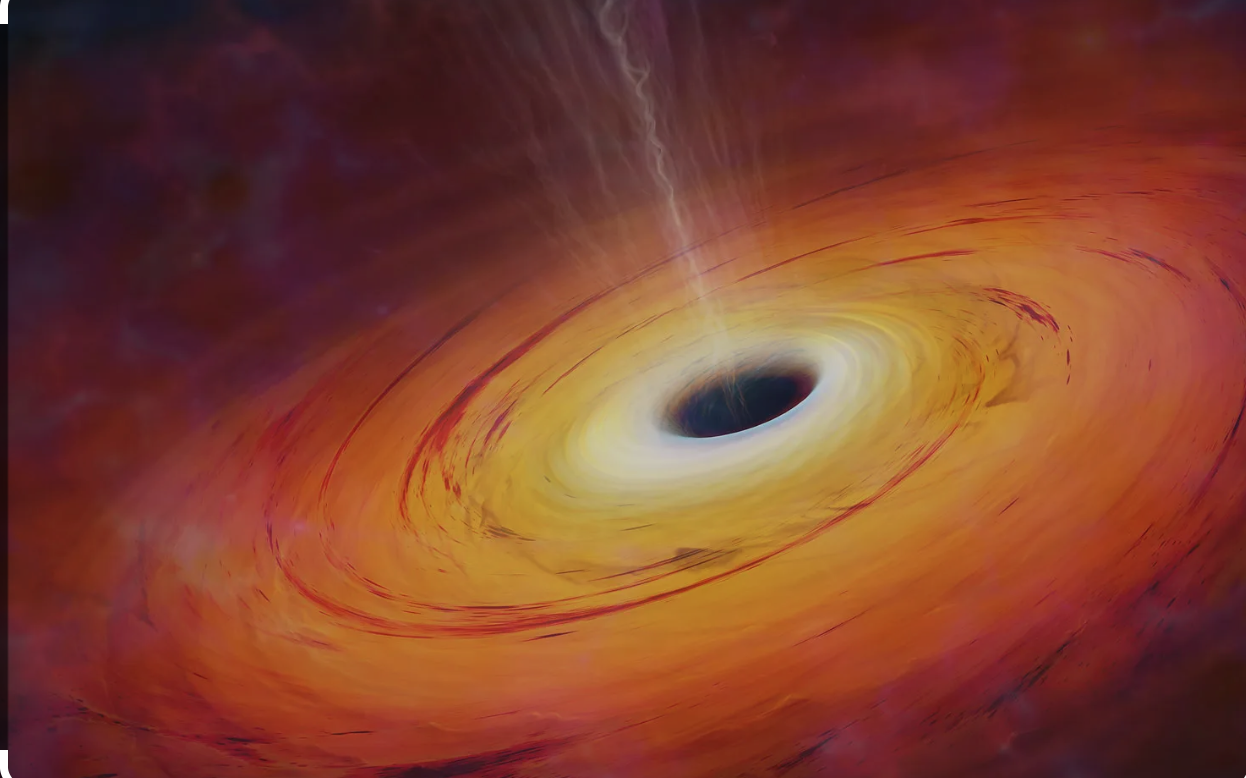
Australian scientists announced last month that they discovered a black hole so immense that it swallows the equivalent of one sun every day. For those unfamiliar with astronomy, black holes are regions in space where matter becomes so tightly packed that gravity overwhelms all other forces, even light. Because no light can escape, black holes are essentially invisible to the eye. They are believed to be formed by stars collapsing in on themselves, which then grow by sucking in other astral matter such as stars, planets, and light itself. As these objects are spinning toward their death, they become superheated and can be seen as a spectacular visible glowing ring, known as a quasar (shown above). Quasars are how black holes are ultimately detected.
The numbers associated with the black hole discovered by the Australians are quite literally astronomical. For example, it has a mass of 17 billion suns, and the surrounding quasar is 500 trillion times brighter than the sun. In view of its size, the researchers wrote, “It’s a surprise it has remained undetected until now, given what we know about many other, less impressive black holes. It was hiding in plain sight.”
Science may be surprised to discover an invisible black hole that is, “hiding in plain sight” of an incredibly bright quasar. But it is the essence of faith to discover an invisible God hiding in plain sight of creation. The Apostle Paul expresses it this way, “For since the creation of the world God’s invisible qualities – his eternal power and divine nature – have been clearly seen, being understood from what has been made, so that people are without excuse.” (Romans 1:20) Just as a quasar points to a black hole, creation itself points to God. Indeed, “The heavens declare the glory of God, the skies proclaim the work of his hand.” (Psalm 19:1)
Although Scripture tells us, “we walk by faith, not sight” (2 Corinthians 5:7), sight is essential because faith is rooted in what is seen. Whether it is something as immense as a quasar or as small as the birds of the air and lilies of the field, our faith in a Creator is stirred as we meditate on the beauty and undeniable miracle of what light reveals to our eyes. Moreover, faith is not a “one and done” experience, but daily renewal. “Though outwardly we are wasting away, yet inwardly we are being renewed day by day. … So we fix our eyes not on what is seen, but on what is unseen, since what is seen is temporary, but what is unseen is eternal.” (2 Corinthians 4:16,18)
God is invisible, “No one has seen God at any time” (John 1:18), but God is not a black hole. Just the opposite – God is light. The Apostle whom Jesus loved wrote, “This is the message we have heard from him and declare to you: God is light; in him there is no darkness at all. If we claim to have fellowship with him and yet walk in the darkness, we lie and do not live out the truth. But if we walk in the light, as he is in the light, we have fellowship with one another, and the blood of Jesus, his Son, purifies us from all sin.” (1 John 1:5-7) The essential function of light is to reveal. Whether it is the physical light of the sun revealing creation, or the spiritual light of the Son revealing the heart, both serve to strengthen our faith journey.
Light is a metonymy for both beauty and virtue in Scripture. As we have seen, for us Christians, an anchor of our faith is the beauty of creation and the wonder of life itself. The earth is but a tiny blip in the universe, surrounded by an infinite expanse of emptiness. That the cold and darkness has never overcome our planet is awe-inspiring. But it is also true that despite a seemingly endless supply of evil in our world, it has never overcome the light of Christ. Has this truth ever been expressed more beautifully than in John’s Gospel? “In the beginning was the Word, and the Word was with God, and the Word was God. He was with God in the beginning. Through him all things were made; without him nothing was made that has been made. In him was life, and that life was the light of all mankind. The light shines in the darkness, and the darkness has not overcome it.” (John 1:1-5) Beauty and virtue are forever linked in our faith journey. It is a matter of where we choose to put our focus – either the wonders of the world or the worries.
Sometimes we forget the promises of our faith and focus on the darkness instead of the light. When a mind is fixed on the worries of the world, it is certain that it will overlook and miss the significance of all that is good and beautiful. And this is most unfortunate because every day we miss the beauty of a new dawn is a day we will not recapture. In Ecclesiastes, we read, “The light of day is beautiful, and sweet to look upon; It’s pleasant for the eyes to see the wonder of the sun.”(Ecclesiastes 11:7). By pausing to reflect on the beauty of each new day, recognizing it as a gift from God, and giving him thanks, we reflect the light of Christ to the world.
In a wonderful book, One Thousand Gifts, Ann Voskamp writes,
“I know there is poor and hideous suffering, and I’ve seen the hungry and the guns that go to war. I have lived pain, and my life can tell: I only deepen the wound of the world when I neglect to give thanks for early light dappled through leaves and the heavy perfume of wild roses in early July and the song of crickets on humid nights and the rivers that run and the stars that rise and the rain that falls and all the good things that a good God gives. Why would the world need more anger, more outrage? How does it save the world to reject unabashed joy when it is joy that saves us? Rejecting joy to stand in solidarity with the suffering doesn’t rescue the suffering. The converse does. The brave who focus on all things good and all things beautiful and all things true, even in the small, who give thanks for it and discover joy even in the here and now, they are the change agents who bring fullest Light to all the world. When we lay the soil of our hard lives open to the rain of grace and let joy penetrate our cracked and dry place, let joy soak into our broken skin and deep crevices, life grows. How can this not be the best thing for the world? For us? The clouds open when we mouth thanks.”(50)
God is hiding in plain sight. When we lay down our worries and look upon the beauty of creation – the great and the small – our eyes start to adjust to a new reality. Overcome with awe, we give thanks with a grateful heart, and bring some of his light to the world.
S
**********
1 Ship out your grain to foreign shores,
across the ocean blue;
And after many days you’ll see,
a gain return to you.
2 Invest in many different things,
diversify your worth;
For you don’t know what evil may,
transpire here on earth.
3 Whenever clouds are full of rain,
it pours down on the ground;
Whenever wind knocks down a tree,
it will not move around.
4 So one who stops to watch the wind,
will surely never sow;
And those who look up at the clouds,
won’t harvest here below.
5 For you don’t know the path of wind,
or whence a baby springs;
Nor do you know the work of God –
the Maker of all things.
6 And thus, sow early in the morn,
and in the day’s last glow;
For you don’t know which crop will thrive,
or whether both will grow.
***
7 The light of day is beautiful,
and sweet to look upon;
It’s pleasant for the eyes to see,
the wonder of the sun.
8 However many years you have,
enjoy what they’ve in store;
For many days of dark will come,
and all will be obscure.
9 Enjoy yourself while you are young,
have fun in what you do;
Obey your heart, but know that God,
will be the judge of you.
10 So banish worries from your heart,
and put away your pain;
Because the days of youth and strength,
too soon are on the wane.
 Pursuit Of Virtue
Dad,
I missed this when it came in last week. What a beautiful and encouraging post! Thank you for writing.
Love,
John
John
LikeLike